


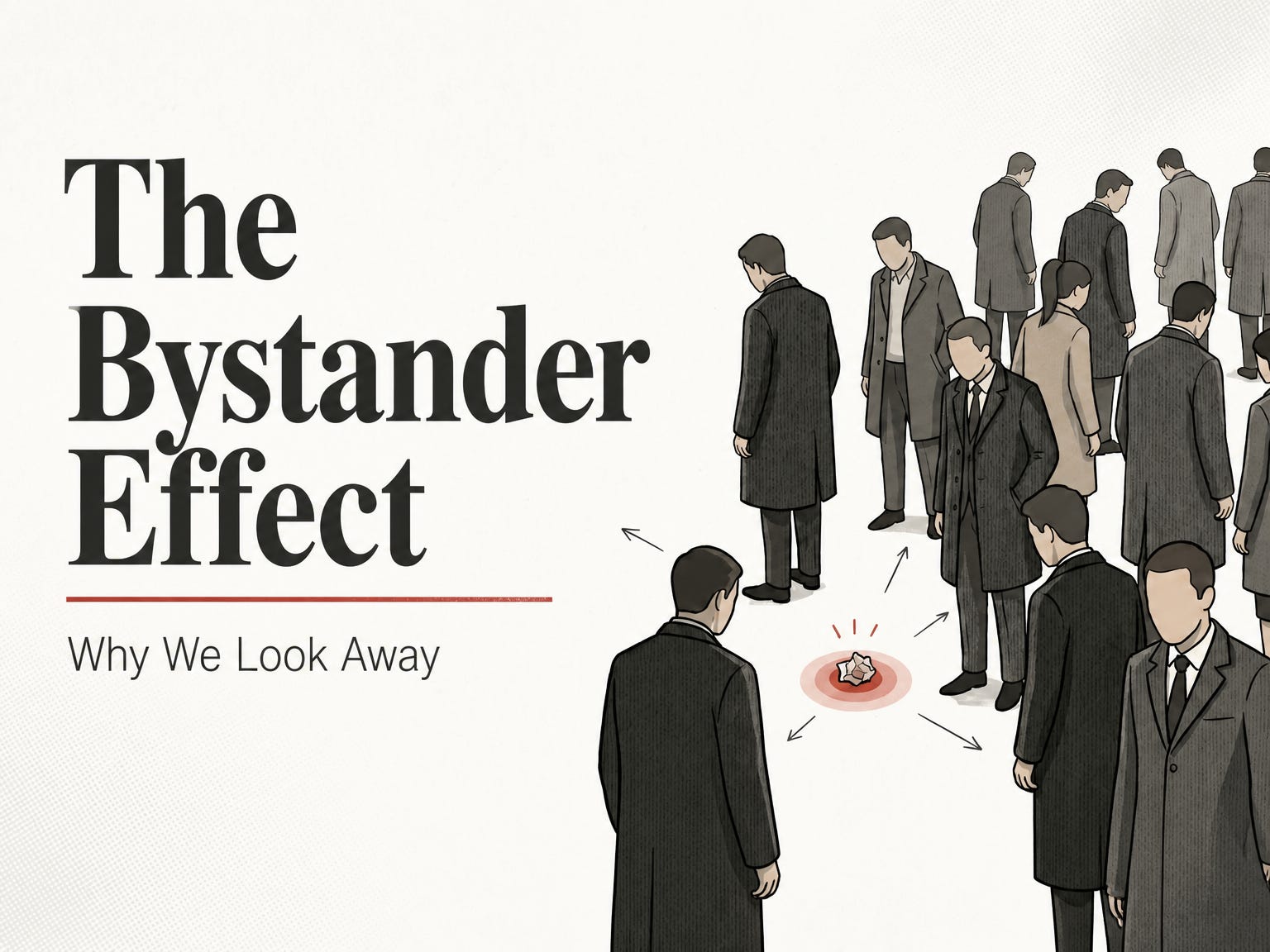
Kitty Genovese was murdered outside her apartment building in Queens in 1964. The attack lasted over half an hour. Newspapers reported that 38 of her neighbors heard her screaming. Nobody called the police until it was too late.
For decades, that story got told the same lazy way: people in cities are cold. Strangers don’t care about each other anymore. It’s a comforting explanation, because it lets you believe you would have been different. You would have picked up the phone.
You probably wouldn’t have. And it has nothing to do with how cold your heart is.
Two psychologists, Bibb Latané and John Darley, got obsessed with this case. They didn’t buy the “apathy” theory, so they dragged strangers into a lab and started setting off fake emergencies to watch what people actually did. What they found flipped the entire story upside down, and it’s a lot more uncomfortable than “people don’t care.”
More witnesses does not mean more help. It means less.
In one experiment, they piped smoke into a room where a subject sat filling out a survey. Alone, 75% of people got up and reported it within minutes. But when the same person sat with two strangers who had been quietly instructed to ignore the smoke and keep filling out their paperwork, only 10% ever got up. The other 90% sat there, eyes stinging, glancing sideways, and did nothing. Some later said they assumed it was air conditioning vapor, or steam, or a test of some kind. Nobody wanted to be the one who overreacted in front of the group.
In another version, subjects thought they were having a casual conversation with other people over an intercom. One person, planted by the researchers, would suddenly fake a seizure mid-sentence, choking and gasping for help. When a listener believed they were the only other person on the call, 85% rushed to help within a minute. When they believed four other people were also listening, that number dropped to 31%. Some never helped at all, even as the choking got worse.
This is not a story about bad people. It’s a story about the math of a crowd.
Latané and Darley called it diffusion of responsibility. When you’re the only witness, 100% of the obligation sits on your shoulders. There’s nobody to hide behind. But the second a second person appears, that obligation splits. With five witnesses, everyone is quietly carrying roughly a fifth of the responsibility, and a fifth of guilt is a lot easier to live with than the whole thing. Nobody decided to let Kitty Genovese die. Thirty-eight people independently decided that surely, someone else already had it covered.
There’s a second force working alongside it, one that’s arguably sneakier: social proof. In an ambiguous situation, your brain doesn’t just ask “should I help?” It asks “do the people around me look worried?” If everyone else in the room is calmly ignoring the smoke, your brain concludes the smoke must be fine. You are not reading the emergency. You are reading the room. And everyone in the room is reading everyone else, which means an entire group of frightened, uncertain people can collectively perform calm right up until it’s too late to act.
This is why the bystander effect is one of the most replicated findings in all of psychology. It has shown up in fights, medical emergencies, online harassment, workplace misconduct, house fires, and car accidents. It shows up any time there’s an audience and a decision that nobody wants to be the one to make first.
Latané and Darley eventually mapped out the exact chain of decisions a bystander has to make before they act, and it turns out there are five separate off-ramps where someone can quietly opt out without ever deciding to be a bad person.
Notice the event. If you’re staring at your phone, you don’t even register that something is happening.
Interpret it as an emergency. Ambiguous situations get read as fine, because assuming it’s fine is socially safer than overreacting.
Assume personal responsibility. With a crowd around, responsibility feels shared, which means it feels smaller.
Know what to do. Even a caring person will freeze if they have no idea how to help.
Actually act. Fear of embarrassment, of misreading the situation, of making it worse, can jam the decision even after the first four steps are cleared.
A person can fail at any single one of those five steps and walk away having done nothing, while still telling themselves, honestly, that they’re a decent person who simply didn’t realize, wasn’t sure, or thought someone else had it handled.
That’s the part that should actually unsettle you. This isn’t a flaw in cruel people. It’s a flaw baked into how every single one of us processes a crowd. You have already failed one of these five steps at some point in your life. So have I.
Here’s the good news buried in all that cold math: because the failure points are so precisely mapped, so is the fix. And the fix isn’t “be a better person.” It’s a lot more mechanical than that.
If you’re the one who needs help, stop broadcasting to the crowd. “Somebody help me” gets diffused across every person listening, and diffused responsibility is exactly what kills the odds of a response. Point at one person. Say their description, their jacket color, anything specific. “You, in the red jacket, call 911.” The second you collapse the group into a single named individual, you hand them all 100% of the responsibility back. There is no one left to hide behind.
If you’re the one standing in the crowd, be the first domino. Every experiment above shows the same hinge point: the instant one person breaks from the group and acts, the diffusion collapses and other people follow almost immediately. You don’t need permission from the room. You need to be willing to look like the person who overreacted, because being wrong and looking silly costs you nothing next to the alternative.
And if you want the version of this that’s less about burning buildings and more about your actual week: this exact same math runs quietly through comment sections, group chats, meetings, and Slack channels. Someone says something wrong, unkind, or clearly false in a group of twenty people, and everyone assumes somebody smarter or braver than them will say something. Usually, nobody does. Not because the room is full of cowards, but because the room is full of people doing exactly what Latané and Darley’s subjects did: reading everyone else’s calm face and deciding the silence must mean it’s fine.
It is very rarely fine. It’s just thirty-eight people, each one certain someone else already made the call.
So the next time you’re the second person to notice something is wrong, skip the math the room is running for you. Don’t wait to see what the crowd does. Be the one who breaks first.
What struck me most is how you turned a familiar story into something much more personal. It’s a powerful reminder that courage often begins with one person choosing to act instead of waiting for someone else to go first. 🩷