Someone borrowed my favorite book last year. Never gave it back.
I keep thinking about it. Not expensive, but my book. Gone. That nagging feeling? Still there sometimes.
Then a stranger at a book fair gave me a whole box of books to clear his shelf. I was happy, read a few, stacked it in my shelf. Never bothered much.
Same me. Losing mine haunts, getting extras? Nice but gone fast.
There’s actually a name for this
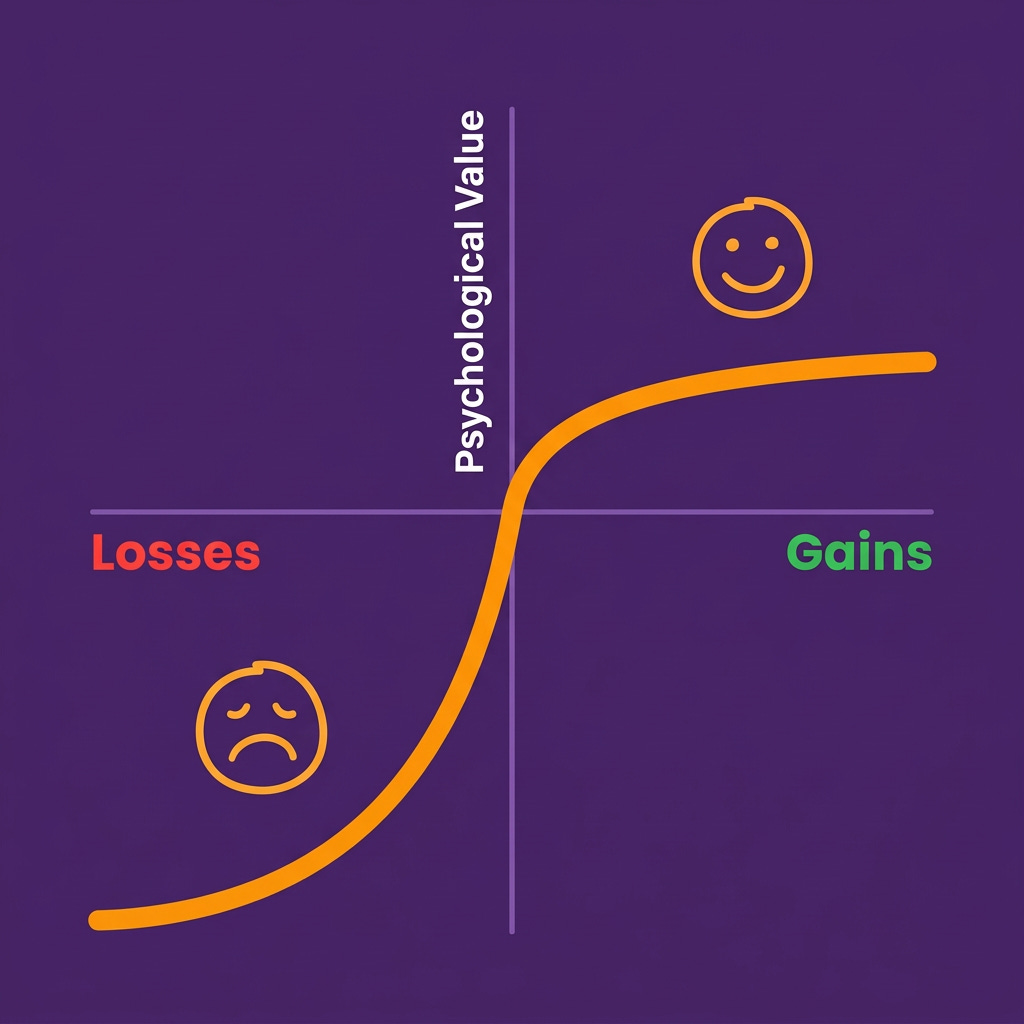
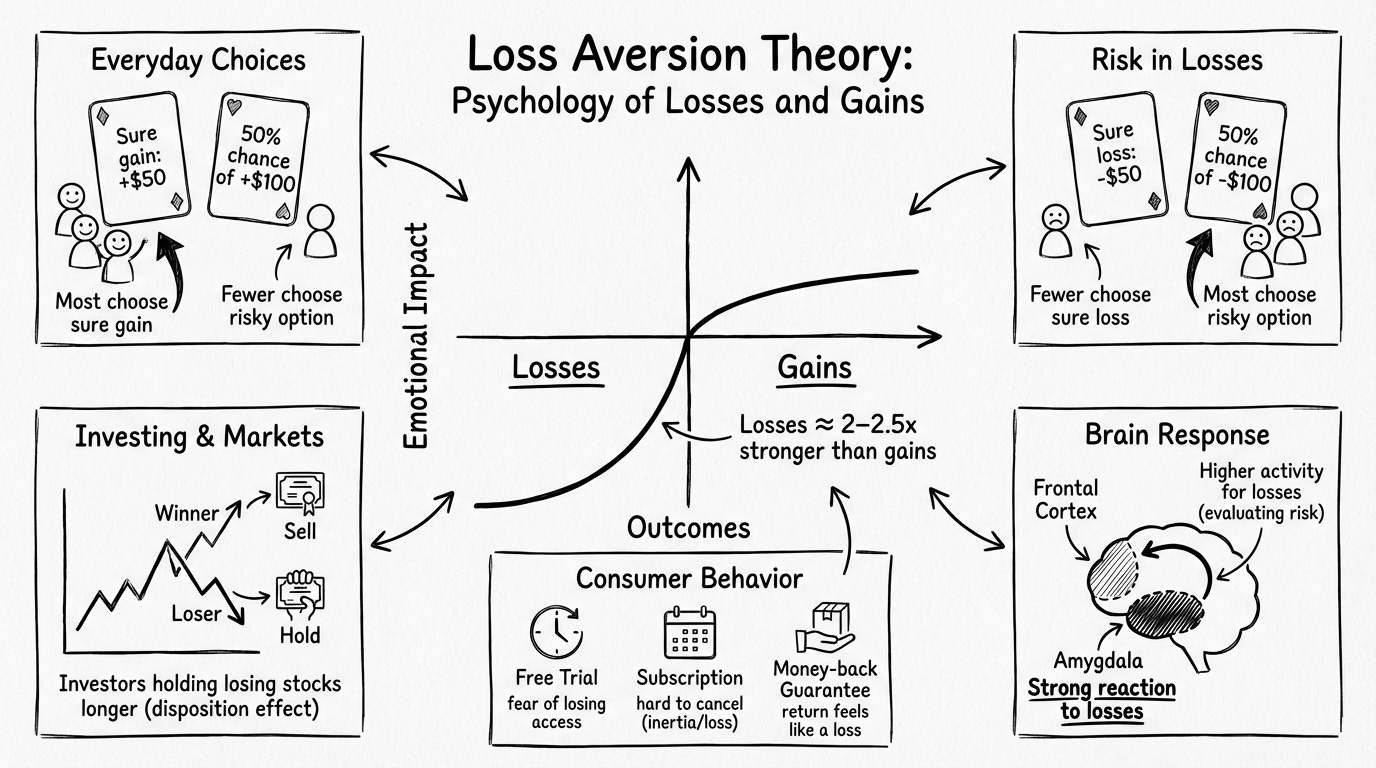
Two psychologists — Kahneman and Tversky — figured out in 1979 that losing something hurts about twice as much as gaining the same thing feels good.
They called it loss aversion.
And honestly, once you know about it, you start seeing it everywhere.
Here’s an experiment they actually ran on people:
“Flip a coin. Heads — you win AED 200. Tails — you lose AED 100. Want to play?”
Most people said no.
But that’s a genuinely good deal mathematically. The only reason to say no is because the imagined pain of losing AED 100 felt bigger than the imagined excitement of winning AED 200.
You know that feeling when a movie is clearly bad — 40 minutes in — but you stay anyway because you already paid?
That’s it. Right there.
You’re not staying because the movie got better. You’re staying because leaving feels like losing the money you spent. Even though you already spent it. Even though staying makes it worse.
We do this with jobs. Relationships. Business ideas that stopped making sense two years ago.
The trap isn’t losing. It’s letting the fear of loss make the decision.
Rich or poor, experienced or not — this bias spares no one. Research shows that for wealthy individuals, the fear of losing a fortune actually exceeds the emotional joy of gaining more wealth, making them more anxious, not less.
The antidote isn’t to become fearless. It’s to name the feeling before it votes.
Next time you’re about to hold on to something that isn’t working, ask yourself: “Am I keeping this because it’s genuinely good for me — or because letting go feels like losing?”
That one question creates a pause. And in that pause, you get your decision back.
That’s it, thanks for reading! Hope this one sits with you this week. 🙏 (Below section is for nerds — a further deep dive.)
— Sabith
For Nerds: Further Deep Dive
Loss aversion was first described by Kahneman & Tversky (1979) in “Prospect Theory: An Analysis of Decision under Risk,” published in Econometrica — the most cited paper in economics history. A 2020 multi-country replication study by Columbia University researchers confirmed its cross-cultural validity
The Core Principle
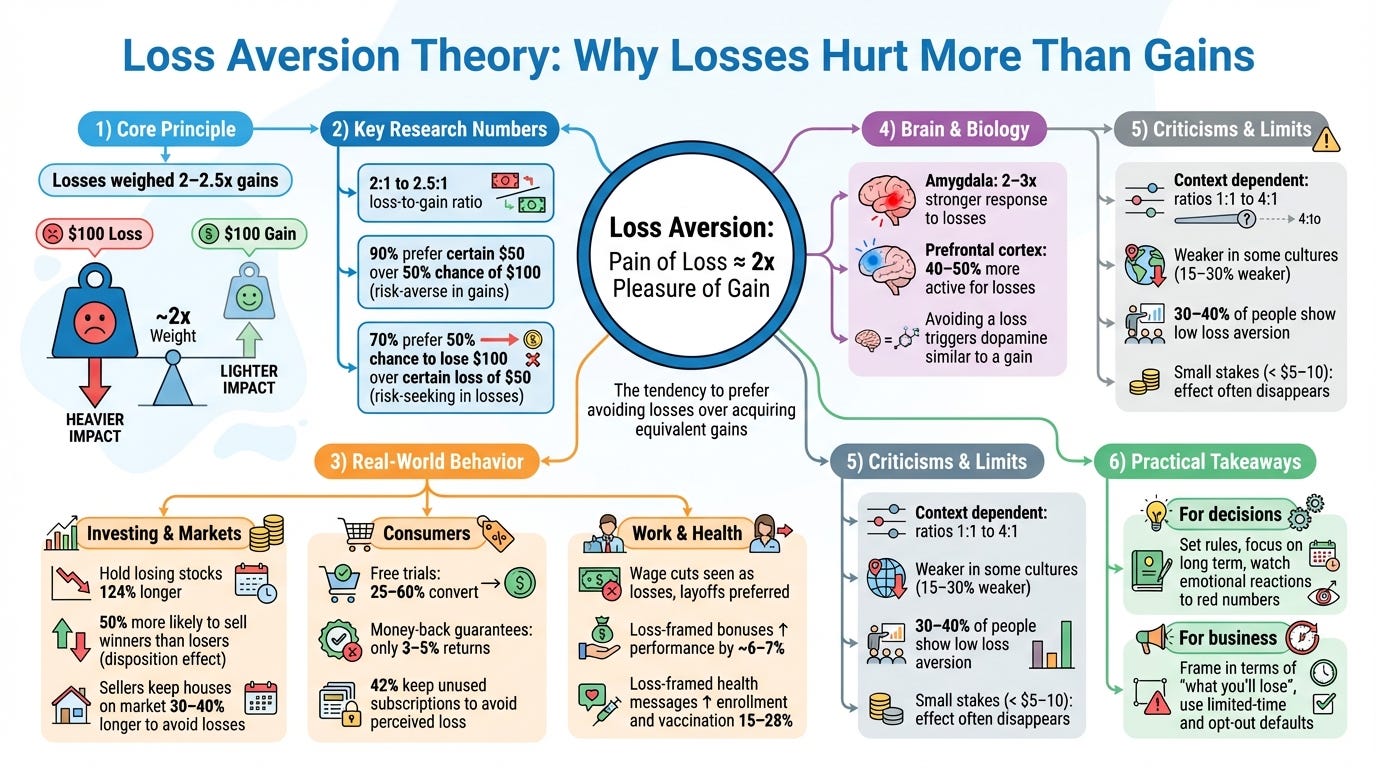
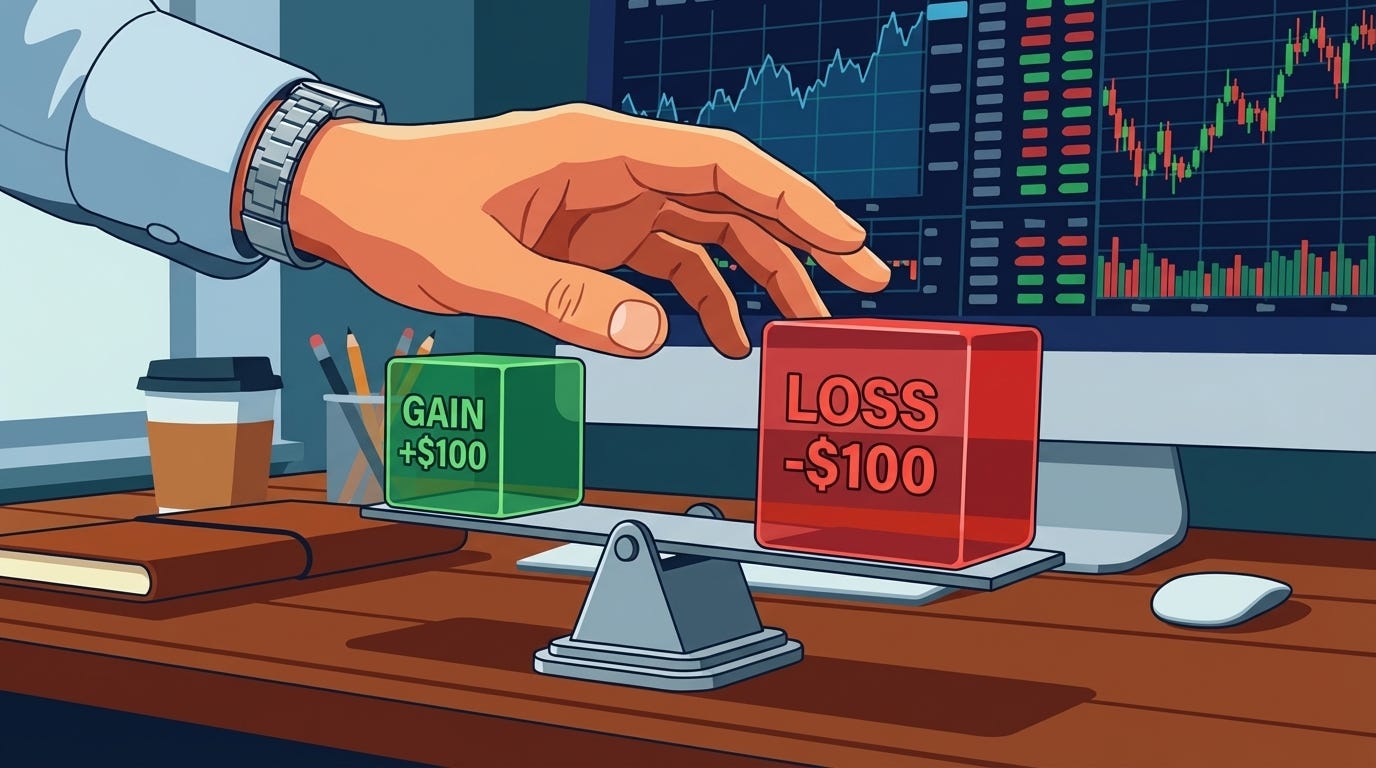
The fundamental principle of loss aversion can be expressed mathematically: losses are typically weighted approximately 2 to 2.5 times more heavily than equivalent gains. This means that losing $100 feels roughly twice as bad as gaining $100 feels good.
Research consistently shows that people require potential gains of approximately $200 to offset the psychological impact of a potential $100 loss.
Key Statistics and Research Data
Original Research Findings
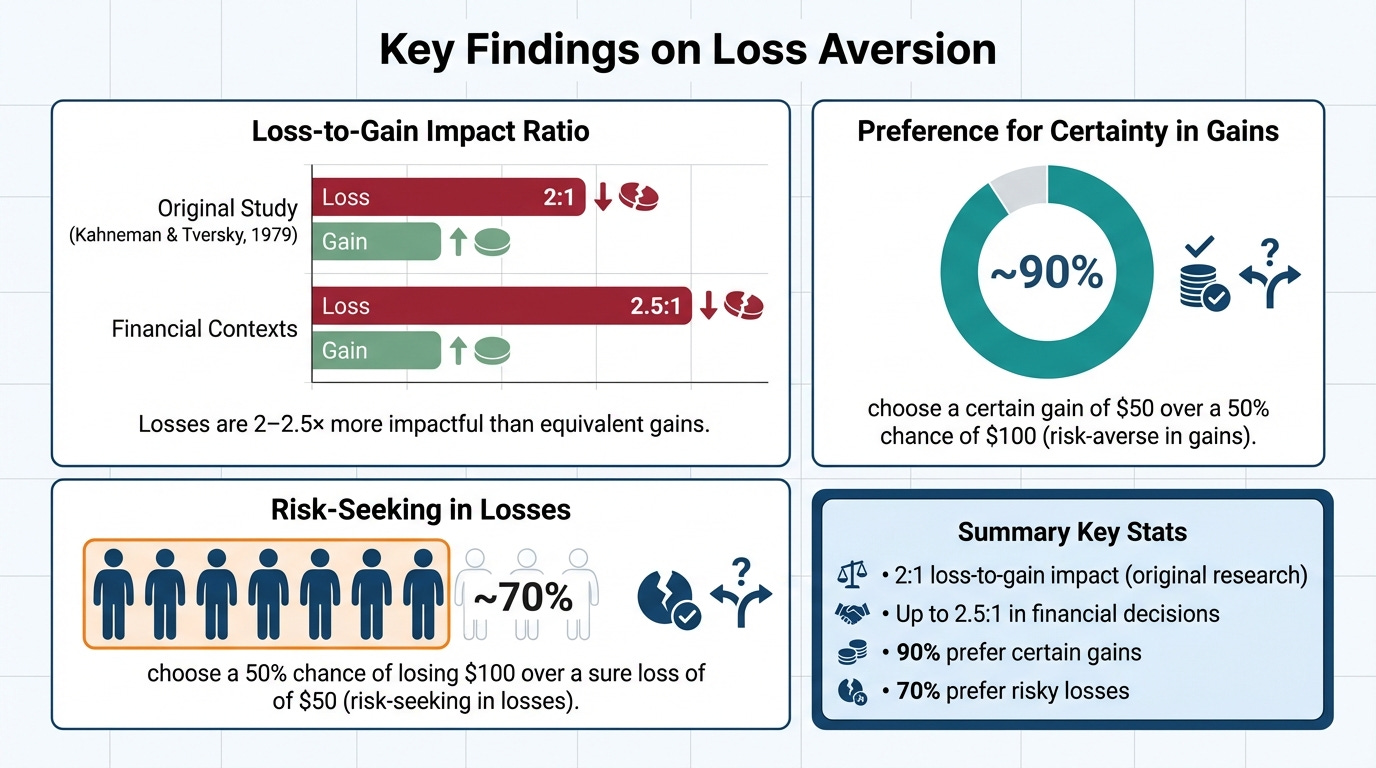
2:1 Loss-to-Gain Ratio: Kahneman and Tversky’s original 1979 study found that losses are approximately 2 times more impactful than gains of the same magnitude.
2.5:1 in Financial Contexts: Subsequent research in financial decision-making found the ratio can be as high as 2.5:1, with some studies reporting ratios between 1.5 and 2.5 depending on context.
90% Preference for Certainty: In experiments, approximately 90% of participants chose a certain gain of $50 over a 50% chance of winning $100, demonstrating risk aversion in gains.
70% Risk-Seeking in Losses: Conversely, about 70% of participants chose a 50% chance of losing $100 over a certain loss of $50, showing risk-seeking behavior when facing losses.
Market and Investment Data
Stock Market Holding Patterns: Studies show that investors hold losing stocks approximately 124% longer than winning stocks, demonstrating reluctance to realize losses.
Disposition Effect: Research analyzing over 10,000 brokerage accounts found that investors were 50% more likely to sell winning investments than losing ones, even when the losing investments had worse prospects.
Housing Market Behavior: Data from real estate markets shows that sellers are willing to keep properties on the market 30-40% longer to avoid selling at a loss, even when market conditions suggest lower future prices.
Trading Volume Impact: Studies indicate that during market downturns, trading volumes can decrease by 35-40% as investors avoid realizing losses.
Real-World Applications and Impact
Consumer Behavior
Loss aversion shapes how we shop and spend:
Free Trial Conversions: Companies offering free trials see conversion rates of 25–60%. Why? Canceling feels like losing something you already have.
Money-Back Guarantees: Only 3–5% of people actually return products with money-back guarantees. Once you own something, giving it back feels like a loss.
Subscription Services: Nearly half (42%) of subscribers keep paying for services they barely use just to avoid the feeling of losing access.
Workplace and Salary Negotiations
Wage Rigidity: During tough economic times, employers would rather cut 10–15% of their workforce than reduce everyone’s salary by the same amount. That’s because pay cuts feel like major losses to employees.
Bonus Framing: Here’s a fascinating trick: when bonuses start high and get reduced for missed targets (rather than starting low and increasing for success), employee performance jumps by 6–7%. Nobody wants to “lose” money they were shown.
Health and Insurance
Health Insurance Enrollment: Telling people they’ll lose money without insurance works 23–28% better than telling them they’ll save money with it.
Vaccination Rates: Messages focused on what you lose by skipping vaccines are 15–20% more persuasive than messages about the benefits of getting vaccinated.
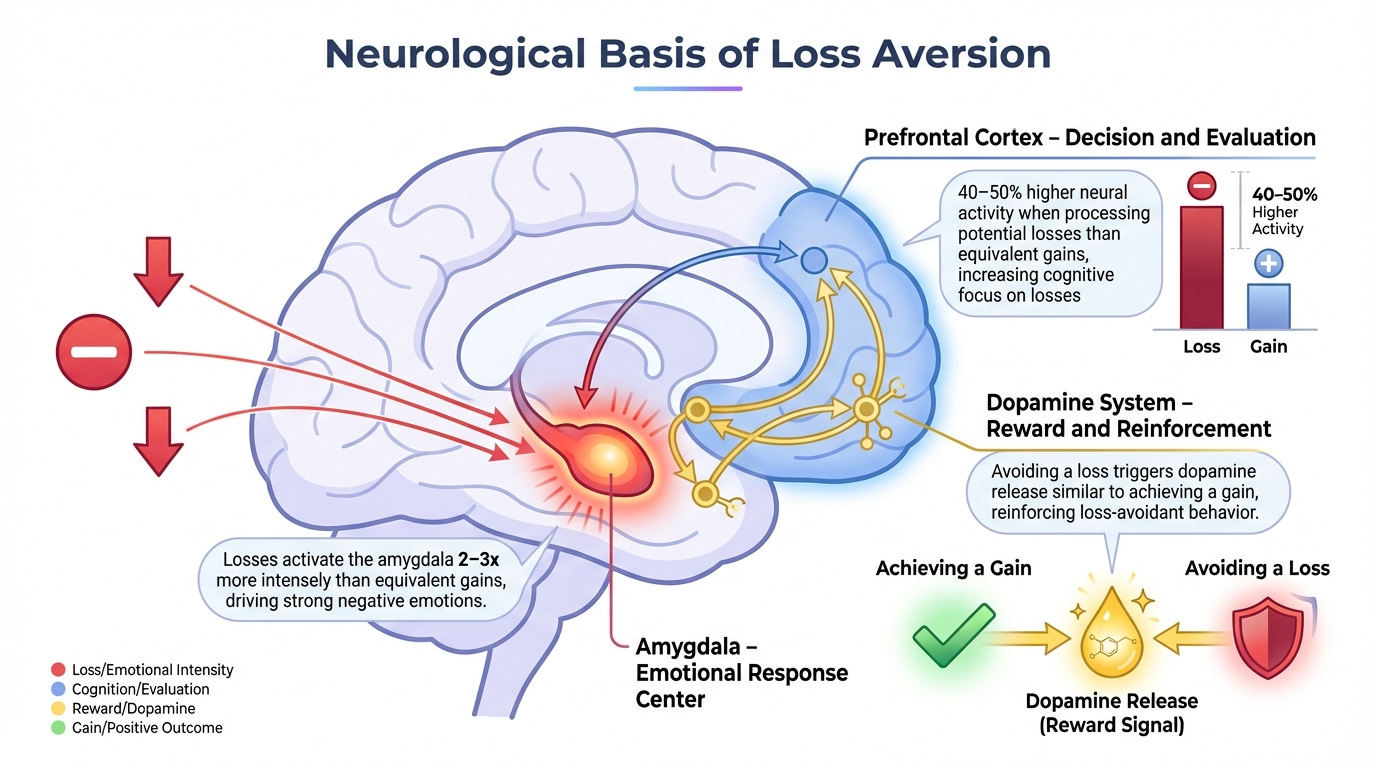
Neurological Basis
Modern neuroscience research has identified the biological foundations of loss aversion:
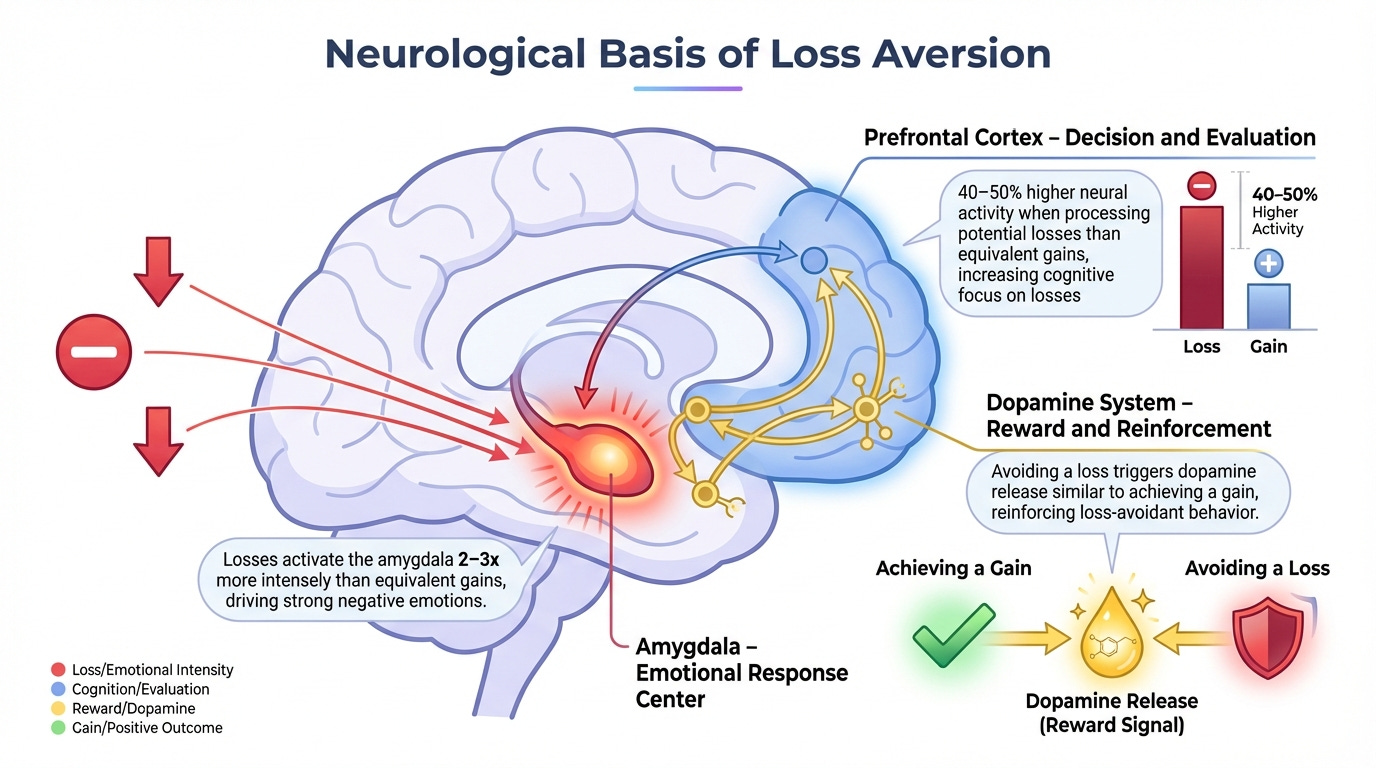
Amygdala Activation: Brain imaging studies show that losses activate the amygdala 2-3 times more intensely than equivalent gains, explaining the emotional intensity of losses.
Prefrontal Cortex Response: The prefrontal cortex shows heightened activity when processing potential losses, with neural activity levels 40-50% higher than when processing gains.
Dopamine Release: Research indicates that avoiding a loss triggers dopamine release similar to achieving a gain, reinforcing loss-avoidant behavior.
Criticisms and Limitations
While loss aversion is widely accepted, some researchers have raised important considerations:
Context Dependency: The loss aversion ratio varies significantly across contexts, with some studies finding ratios as low as 1:1 or as high as 4:1.
Cultural Variations: Cross-cultural research shows that loss aversion effects are 15-30% weaker in collectivist cultures compared to individualistic ones.
Individual Differences: Approximately 30-40% of individuals do not exhibit strong loss aversion, suggesting significant personal variation.
Small Stakes Exception: For very small amounts (under $5-10), loss aversion effects diminish or disappear entirely in about 60% of tested scenarios.
Practical Implications
For Decision Making
Understanding loss aversion can improve personal and professional decisions:
Recognize when loss aversion is clouding judgment, particularly in investment decisions
Set predetermined rules for selling investments to override emotional responses to losses
Reframe decisions to focus on long-term outcomes rather than immediate losses
Use mental accounting to separate different financial decisions and reduce compound loss aversion effects
For Business
Businesses leverage loss aversion to improve outcomes:
Frame offers to emphasize what customers stand to lose rather than gain (e.g., “Don’t miss out” vs. “Get this deal”)
Use limited-time offers to create urgency and fear of losing the opportunity.
Implement opt-out rather than opt-in programs, as people are reluctant to lose default benefits.
Summary Infographic