


In 1961, a meteorologist named Edward Lorenz made a mistake that turned out to be one of the most important mistakes in scientific history.
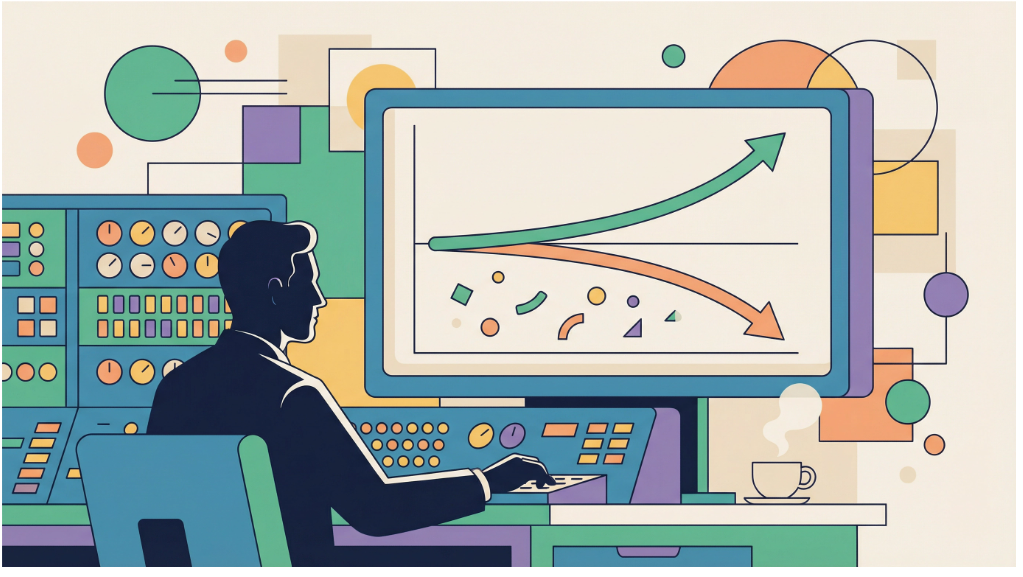
He was running a weather simulation on his computer at MIT — a big, clunky machine that filled most of the room.
To save a bit of time, Lorenz decided to restart a simulation from the middle. Instead of running it from the beginning, he typed in the numbers from a previous printout. He entered the number .506 and, with the machine humming away, went to get a cup of coffee.
When he returned an hour later, he saw something that shouldn’t have been possible. The new weather simulation was completely different from the original. The two weather patterns, which started from almost the exact same point, had diverged so wildly that they bore no resemblance to each other.
Lorenz checked his equations. He checked the computer. Nothing was broken. Then he found the source of the error. The original number from the computer’s memory was not .506. It was .506127.
A difference of 0.000127. Basically nothing. A rounding error smaller than a grain of sand — and the model had generated a different world.
Lorenz spent a while checking for bugs. There weren’t any. The math was right. The computer was fine. The problem was something deeper: the system itself was so sensitive that the tiniest nudge at the beginning changed everything downstream.
He had accidentally discovered chaos theory.
The Hidden Principle: Why Your World is Less Predictable Than You Think
What Lorenz stumbled upon is a principle that governs our world, yet runs counter to almost all our intuition. We are taught that similar inputs should lead to similar outputs. If you swing a golf club with almost the same force and angle, the ball should land in almost the same place. If you follow a recipe with almost the same ingredients, you should get almost the same cake.
This is the world of linear systems. It’s predictable, it’s controllable, and for many simple things, it’s true.
But Lorenz had discovered that many systems in the real world—the weather, the stock market, the human body, the course of history—are not linear. They are chaotic. And in a chaotic system, the core principle is this:
Tiny, almost immeasurable changes in starting conditions can lead to enormous, wildly unpredictable differences in the final outcome.
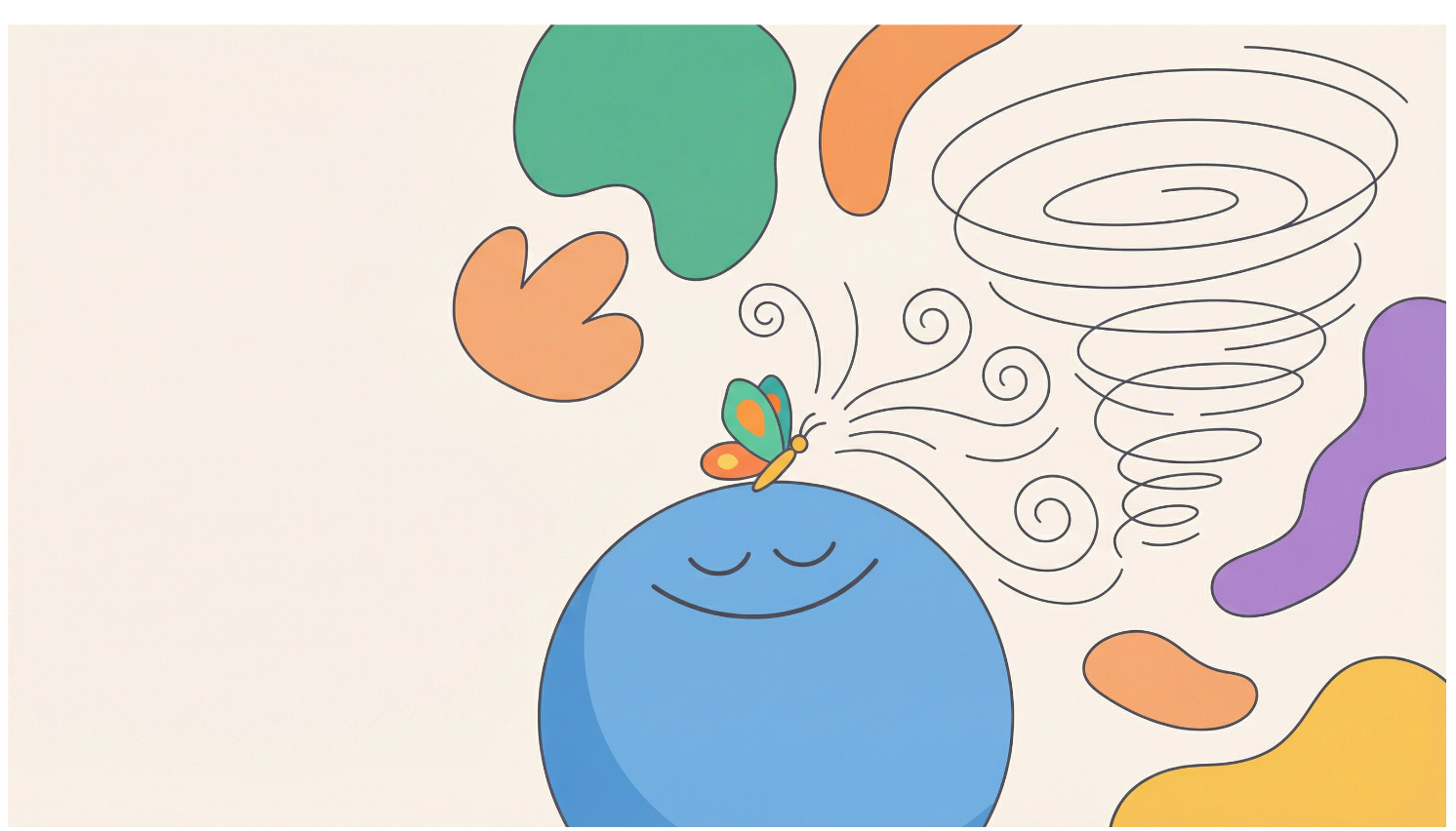
This is what Lorenz famously called “The Butterfly Effect.” He gave a famous lecture with a question as its title: “Does the flap of a butterfly’s wings in Brazil set off a tornado in Texas?” He wasn’t being poetic. He was describing a real feature of chaotic systems — that tiny causes can have enormous effects, through chains of events so long and tangled that tracing the connection back is practically impossible. The butterfly effect gets misunderstood a lot. People hear it and think it means everything is random, or that nothing matters, or that the universe is basically a coin toss. It doesn’t mean any of that. It means the opposite, actually. Every single thing matters. The butterfly’s wings matter. The 0.000127 in Lorenz’s equation mattered enormously. A seemingly irrelevant nudge can propagate through a complex system and change everything. Which makes the world both more frightening and more interesting to live in.
Strange Attractors: The Order Inside the Chaos
Here’s the part that surprised everyone, including Lorenz.
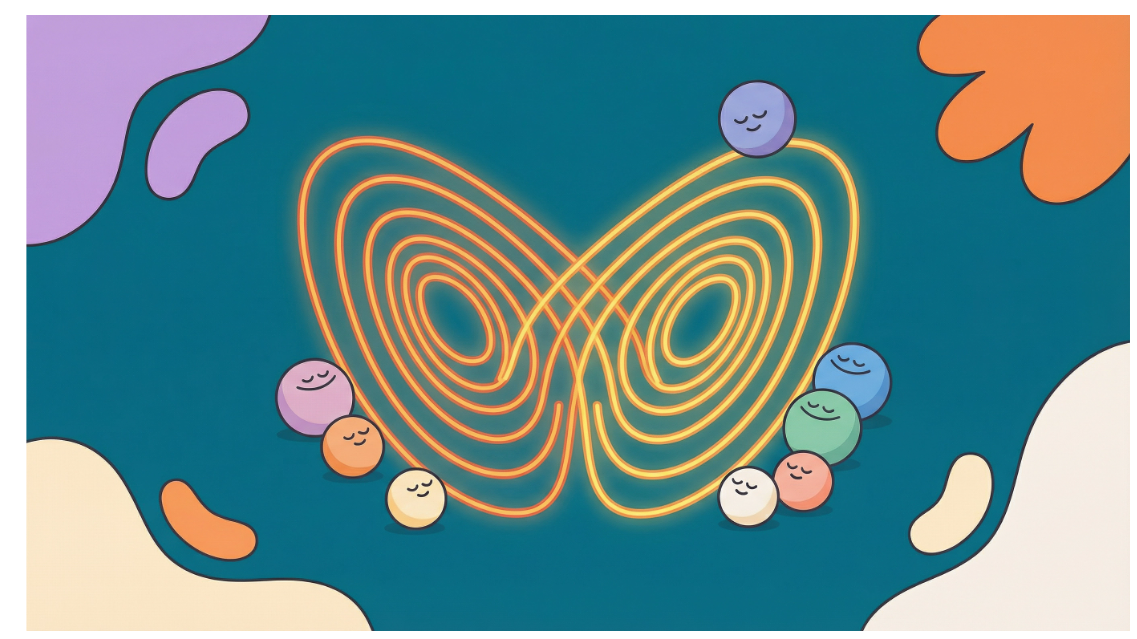
When he plotted the output of his equations over time, he expected either a fixed pattern or a mess. Instead, he got something in between — a shape that looped and spiraled, never repeating exactly, never settling into a steady state, but also never flying off into infinity. It stayed within bounds. It had a shape.
He called it a strange attractor. It looked, oddly, like a butterfly.
The strange attractor reveals that even chaotic systems have a hidden structure. The system doesn’t go everywhere. It wanders within a particular geometric territory, tracing a path that’s impossible to predict step by step but recognizable as a whole. There’s a kind of order — just not the kind we’re used to.
You can see this in real life. Financial markets are chaotic, but they don’t randomly teleport between $10 and $1 million per share overnight. River turbulence is chaotic, but the river still flows downhill. Your moods are unpredictable day to day, but you’re still recognizably yourself over a decade.
The chaos happens inside a structure.
Fractals: Nature’s Signature
Connected to chaos theory is another idea that took a while to be taken seriously: fractals.
Mathematician Benoît Mandelbrot spent years looking at things that traditional mathematics struggled to describe — coastlines, clouds, trees, price charts — and noticed they all shared something. They were rough at every scale. Zoom into a coastline and the jagged shape you see repeats itself. Zoom in again. Still jagged, still the same rough texture, all the way down.
He called these shapes fractals: objects that are self-similar across scales, built by repeating a simple process over and over.
The Koch snowflake is a clean mathematical example. You start with a triangle, add smaller triangles to each side, then smaller ones to each of those sides, and so on forever. The result has infinite perimeter packed inside a finite area. It’s a paradox you can draw with a pencil.
But the real revelation was that nature uses fractals everywhere. Your lungs, your blood vessels, your neurons — all fractal. The branching of rivers, the structure of clouds, the texture of mountain ranges. Nature doesn’t use smooth Euclidean geometry. It uses recursive processes that generate complexity from simplicity.
And this turns out to be extraordinarily efficient. Your lungs can pack an enormous surface area — roughly the size of a tennis court — into a space the size of a football. DNA doesn’t have to store the location of every blood vessel in your body. It stores a process, a fractal recipe, and the complexity unfolds from that.
Social & Historical Angles on a Chaotic World
Once you have the lens of chaos theory, you start to see its signature everywhere. It’s not just an abstract mathematical idea; it’s a fundamental feature of our reality.
Angle 1: The Wrong Turn That Started the World War
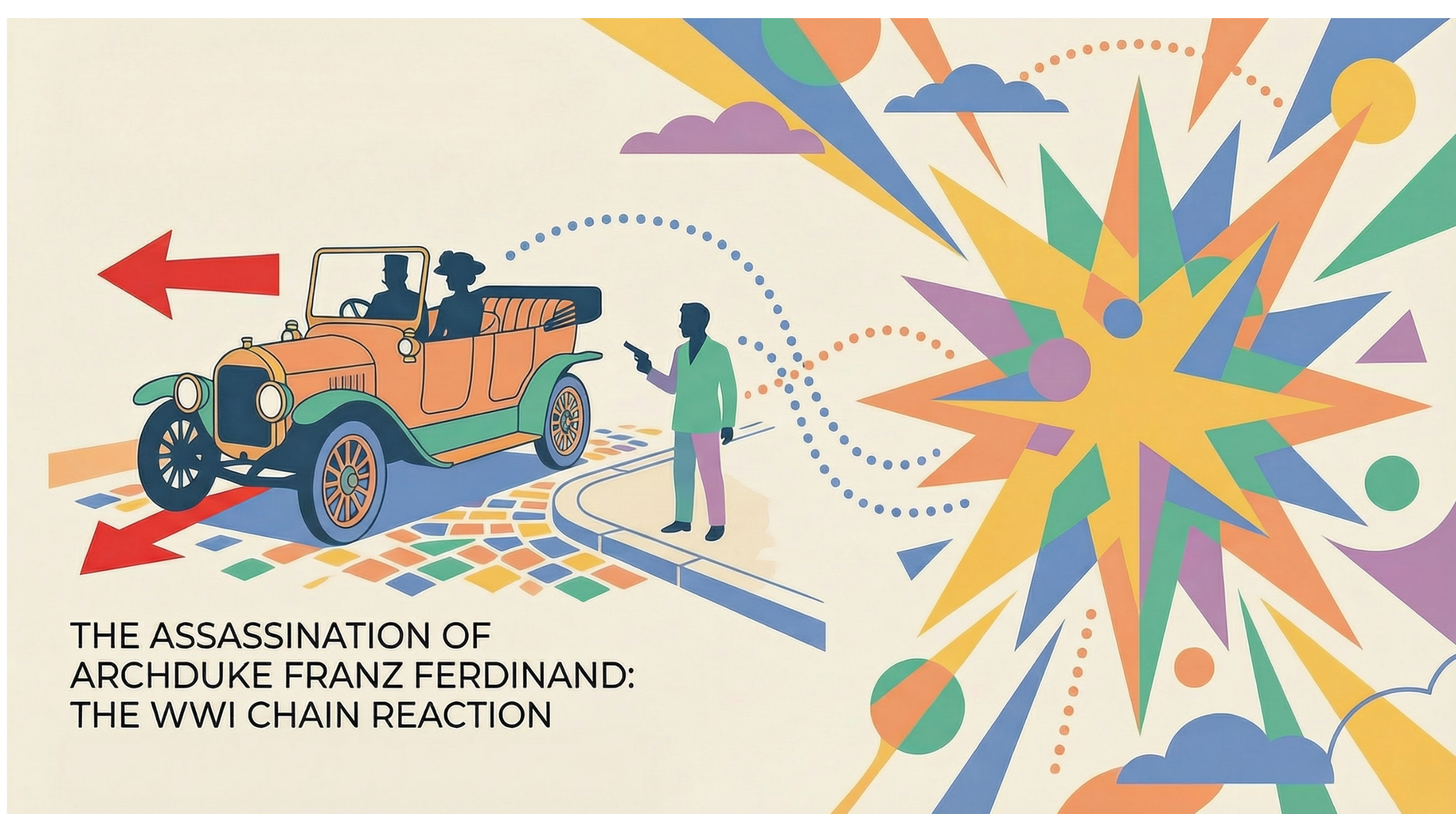
On June 28, 1914, Archduke Franz Ferdinand of Austria was visiting Sarajevo. A group of assassins led by a Bosnian-Serb named Gavrilo Princip had planned to kill him, but their initial attempt failed. The Archduke’s motorcade sped away, and the assassination plot was, for all intents and purposes, over.
Princip, deflated, went to get a sandwich on Franz Joseph Street. Meanwhile, the Archduke’s driver received confused instructions about taking a new route and made a wrong turn — onto Franz Joseph Street. He stopped to turn around. The car stalled directly in front of Princip, who was still holding his sandwich.
Princip seized the opportunity. He fired his pistol, killing the Archduke and his wife. That single, chaotic event—a wrong turn—triggered a chain reaction that led directly to the outbreak of World War I, a conflict that killed 20 million people and redrew the map of the world.
Angle 2: The Rain That Drowned an Empire
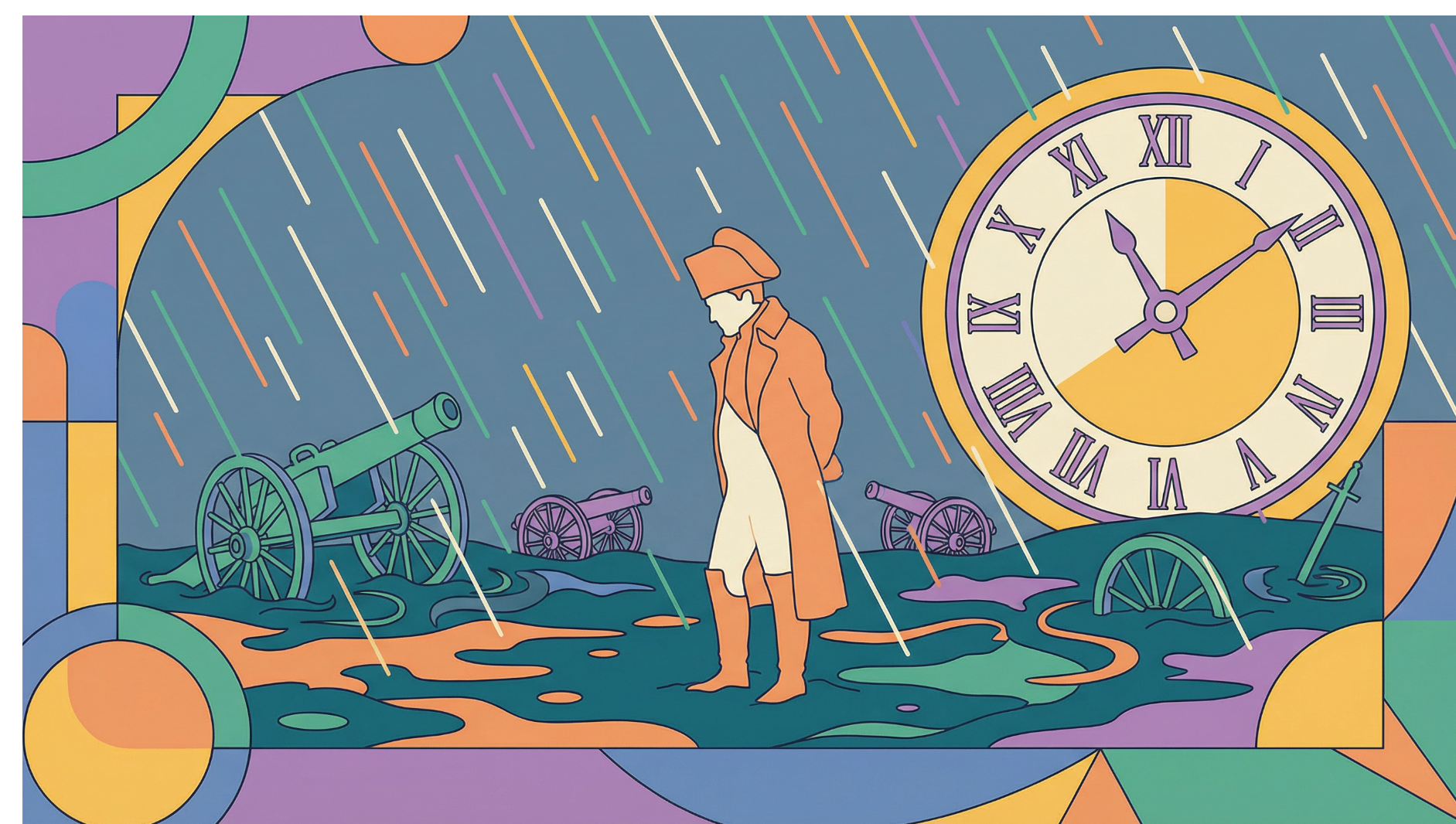
On the morning of June 18, 1815, Napoleon Bonaparte, Emperor of the French, was ready to crush the allied armies at the Battle of Waterloo. He was one of the greatest military commanders in history, and he had a clear plan. But he was thwarted by a tiny, uncontrollable variable: the weather.
A torrential rainstorm the night before had turned the battlefield into a sea of mud. Napoleon knew his greatest strength was his artillery, but the soggy ground would swallow his cannonballs and bog down his cavalry. So he waited. He delayed the attack until 11:30 AM, hoping the ground would dry.
That delay was fatal. It gave the Prussian army, which Napoleon thought he had already defeated, just enough time to march to the battle and reinforce the allied lines. The few hours Napoleon lost waiting for the mud to dry cost him everything. His army was routed, his empire was lost, and the map of Europe was redrawn. All because of the rain.
Theological Lens: Divine Amplification
From a theological lens, chaos theory is not a story of random chance, but of divine amplification — the interplay between human effort and God’s boundless power.
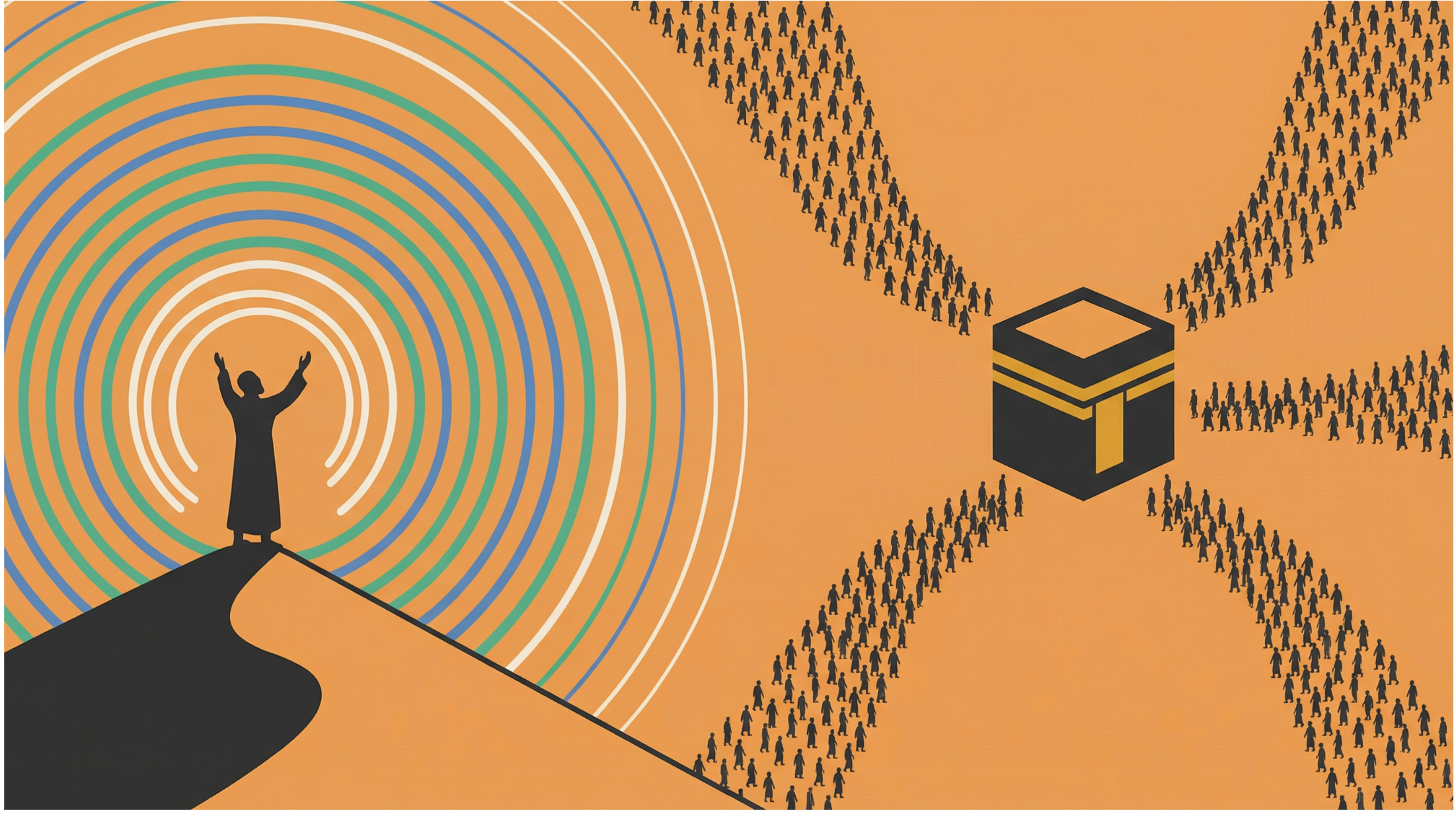
Consider the story of Prophet Ibrāhīm A.S(Abraham). After rebuilding the Kaʿbah in a desolate desert, God commanded him: “And proclaim to the people the Hajj [pilgrimage]; they will come to you on foot and on every lean camel; they will come from every distant pass.” According to classical commentators, Ibrāhīm, standing alone in the wilderness, asked in wonder, “O Lord, how can I convey this to people when my voice will not reach them?” The divine response was simple and profound: “Your duty is only to make the call, and Ours is to deliver it.”
So Ibrāhīm made the call. One man, one voice, in an empty desert. And for four thousand years, humanity has answered. Today, millions of pilgrims circle that same spot every single year, a direct response to the call of a man who wondered if he would even be heard. His single, seemingly insignificant action was the input. God’s power was the unimaginable amplification.
This principle is mirrored in the life of Prophet Yūsuf (Joseph), whose journey from the bottom of a well to the seat of power in Egypt was a chaotic, unpredictable path where every disaster was a divinely guided stepping stone. As Yūsuf himself declared, “Indeed, he who fears Allah and is patient, then indeed, Allah does not allow to be lost the reward of those who do good.”
This is the essence of the divine butterfly effect: our role is the small, sincere action, and God’s is the outcome.
The Prophet Muhammad ﷺ reinforced this by saying, “Do not belittle any good deed, even if it is just meeting your brother with a smiling face,” because in God’s hands, the smallest input—even an atom’s weight of good—can be magnified into a world-changing outcome.
So What Do You Do With This?
The honest answer is: you can’t control outcomes in a chaotic world.
But chaos theory doesn’t actually tell you to stop trying. It tells you something more precise — you can’t control the ending, but you can influence the beginning. Initial conditions are where your leverage is.
Lorenz’s 0.000127 mattered enormously. Princip’s sandwich stop mattered enormously. The driver’s wrong turn mattered enormously. None of those people knew at the time what they were setting in motion.
You won’t know either. That’s the point.
What you can do is make the small choices carefully — the phone call you keep putting off, the book you keep meaning to read, the conversation you’ve been avoiding. These are the butterfly wings. You can’t trace where they go. But they go somewhere.

