


Picture this: You need to order a laptop for work. Simple, right? Wrong. First, you fill out Form A. Then you wait three days for an approval email. Next, you’re redirected to Portal B, which asks you to re-enter the same information. Another approval. Another portal. By the time you finally get that laptop, you’ve clicked through 47 steps and lost half your soul to bureaucracy.
Welcome to organizational sludge—the silent productivity killer that’s costing your company millions and driving your best people to quit.
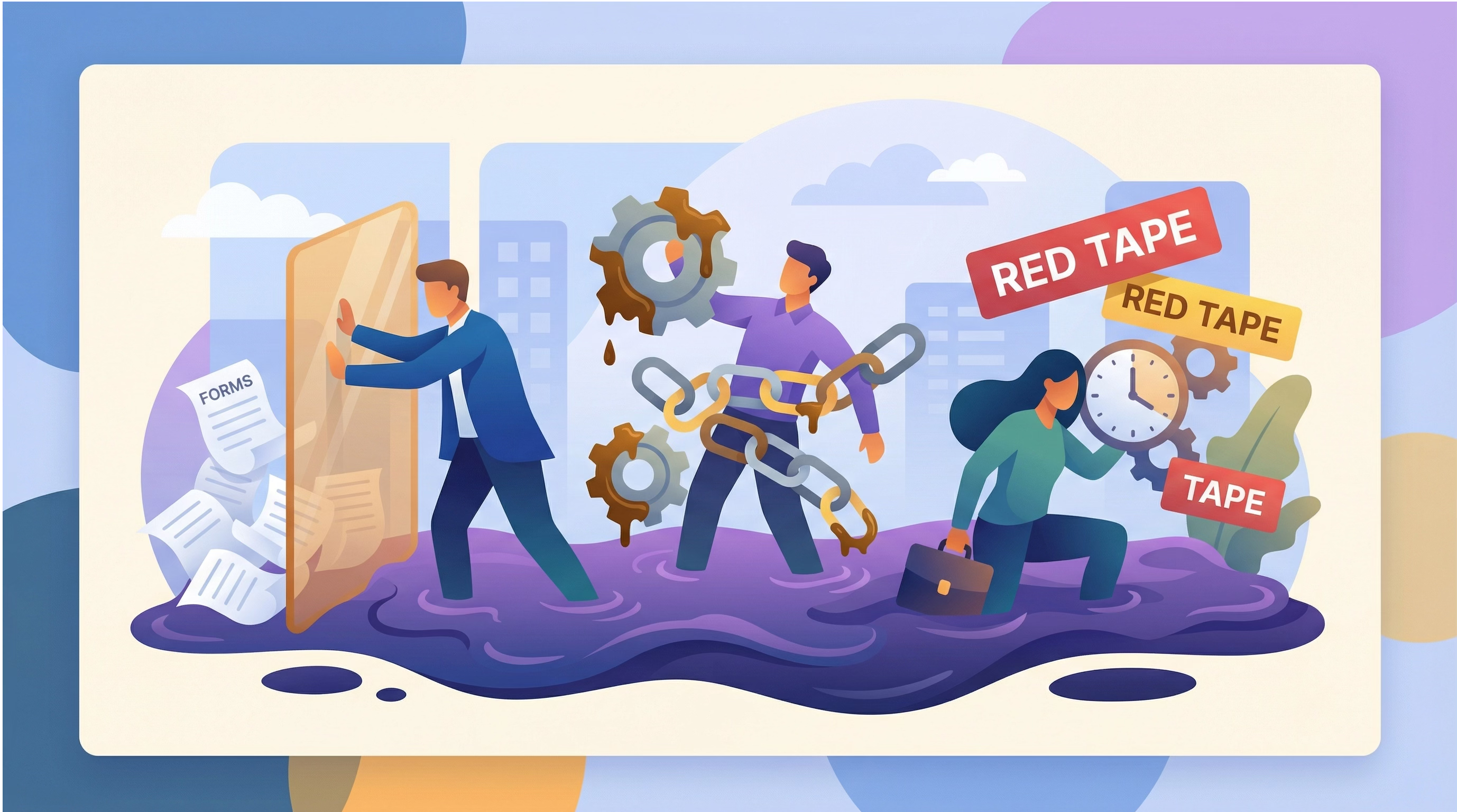
What Exactly Is Organizational Sludge?
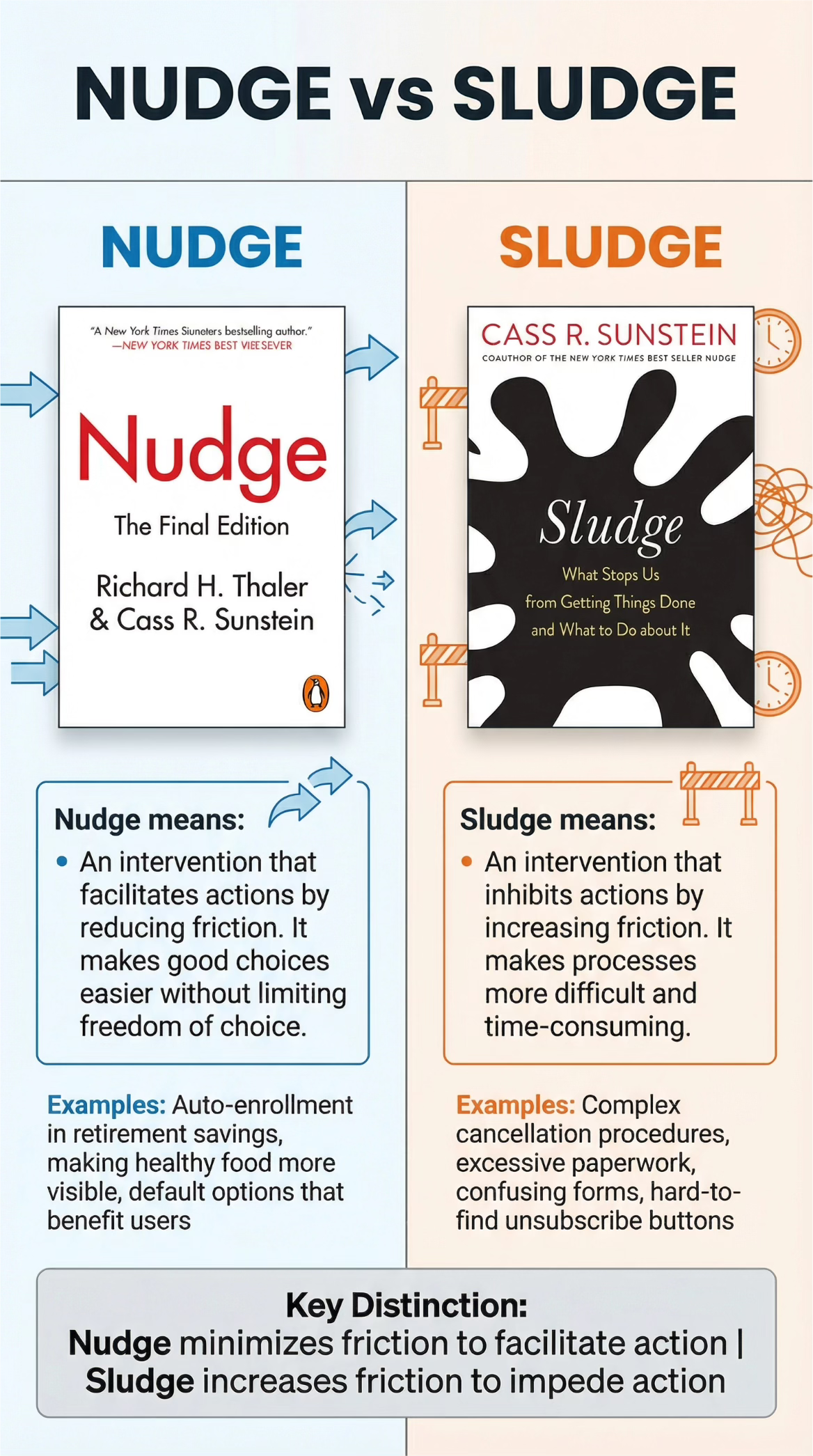
Coined by behavioral scientist Cass Sunstein, “sludge” refers to the excessive friction that makes it harder for people to do what they want or need to do. In organizations, sludge manifests as unnecessary complexity, redundant processes, and administrative obstacles that consume time without adding value.
The term comes from behavioral science. it is the opposite of “nudge”. If a “nudge” makes good behavior easier, sludge makes any behavior harder. And in most organizations, sludge has been piling up for years—layer upon layer of “necessary” processes that nobody has bothered to question.
Sludge takes many forms.
It’s the meeting about the meeting.
The approval that requires five signatures.
The system that logs you out every ten minutes.
The project that nobody remembers starting but everyone’s still updating.
In hospitals, nurses spend more time documenting care than providing it. Some intensive care units tracked 122 separate indicators per patient—most of which nobody ever looked at.
In universities, administrative staff doubled while faculty stayed flat. The teachers didn’t get less work. They just got more administrators telling them how to do it.
In corporations, employees navigate a maze of platforms that don’t talk to each other. Need to update employee details? That’s four different systems, each with its own login.
Consider the employee who needs to submit an expense report. In a sludge-heavy organization, they might need to print receipts, fill out a PDF form, get manager approval via email, forward it to finance, then re-enter everything into an online system. Each step makes sense to someone, somewhere. But collectively, they transform a five-minute task into an hour-long ordeal.
The Real Cost of Sludge
Behavioral economist Cass Sunstein estimates this invisible drag costs the American economy $3 trillion annually—roughly 12% of GDP. That’s not from taxes or regulations alone, but from the sheer weight of overcomplicated processes that nobody’s bothered to question in years.
The U.S. federal government alone imposes 11.4 billion hours of paperwork burden each year. That’s 5.7 million full-time jobs spent just filling out forms. In your organization, the numbers might be smaller, but the pattern is identical: well-intentioned processes pile up until moving forward feels like wading through mud.
How Did We Get Here?
Nobody sets out to create sludge. It accumulates gradually, with the best intentions.
Someone adds a new approval step after a small mistake. A compliance requirement spawns three new forms. Teams create workarounds because the official system doesn’t work, and those workarounds become the new process.
Here’s the key insight: sludge grows asymmetrically. Adding a process is easy. Removing one is nearly impossible.
That well-intentioned form from 1997? Still there. Still wasting everyone’s time. Nobody questions it because “that’s how we’ve always done it.”
Organizations face too many demands at once.
A hospital must treat patients, be community-minded, environmentally responsible, innovation-driven, and cost-efficient.
A school must teach, promote well-being, embrace technology, fight inequality, and satisfy parents.
When leaders try to meet every expectation, they open the door to endless solutions. Consultants pitch new frameworks. Vendors sell new platforms. Internal stakeholders launch new initiatives. The organization becomes an all-you-can-eat buffet of improvement plans.
Fast-changing environments make it worse. Leaders spot a gap and instinctively add something—a new meeting, another report, one more layer of review. They rarely ask what should be removed to make room. The result? Your team is drowning in initiatives, and your best people are quietly planning their exit.
The 6 ‘P’s of Workplace Sludge
Research by André Spicer and Mats Alvesson identifies six common sources of what we call workplace “viscosity.” These usually arise because, when faced with a problem, leaders instinctively think about what to add rather than what to replace or minimize.
1. Policies: Outdated or overly complex rules that govern behavior but add no actual value to the bottom line.
2. Paperwork: Excessive documentation and forms that consume productive hours.
3. Platforms: Confusing digital tools or software that are poorly integrated and hard to navigate.
4. Practices: “The way we do things,” particularly the endless series of meetings that could have been a three-sentence email.
5. Projects: Strategic initiatives that add new tasks to a workload without removing or minimizing old ones. Remember: every new “priority” usually just adds a layer of sludge if it doesn’t replace an old one.
6. Positions: The creation of unnecessary roles or hierarchical layers that complicate decision-making and slow down approvals.
The Two Laws in Play
Two principles explain why organizations spiral into chaos:
Metcalfe’s Law tells us that as you add people to a network, the number of potential connections grows exponentially (n²). Add ten employees to your team, and suddenly you have 45 potential one-on-one relationships instead of 10.
Brooks’s Law warns that adding people to a late project makes it later, not faster. New hires need training. Coordination overhead explodes. Communication becomes a full-time job.
Put them together, and you get organizations where half the day disappears into “alignment meetings” that align nothing.
How to De-Sludge your organization
If you want to reclaim your organization’s time and sanity, you need to become a “Sludge Slayer.” Here’s how:
1. Run a Sludge Audit
Map the journey of a common task from start to finish. Count every click, every signature, every handoff. If booking a meeting room requires 38 separate steps (yes, this happens), you’ve found your enemy.
Ask your team to rate processes on a scale of 0-10 for ease. If they consistently say “2,” believe them. Those ratings tell you where to start.
Google improved employee satisfaction by launching “Bureaucracy Busters,” a program where employees identified the red tape that frustrated them most. They simplified performance reviews and moved from a 41-point scale to a simple 5-point system.
2. Apply the Eliminate-Automate-Simplify Framework
Eliminate first. Can you simply delete this step? The answer is often yes, but nobody’s asked the question in years.
Automate next. Can you make the right action happen by default, so people don’t have to think about it?
Simplify what remains. Break complex forms into small, digestible chunks.
Amazon’s “two-pizza team” rule exemplifies anti-sludge thinking. If a team is too large to be fed by two pizzas, it’s probably too large to make decisions efficiently. Similarly, some companies have implemented “no meeting” days or required that meetings have clear agendas and decisions, not just discussions.
3. Use the 80/20 Rule
Twenty percent of your friction causes 80% of your productivity loss. Focus on the biggest pain points first: onboarding, IT requests, expense approvals, and time-off systems. Fix those, and you’ll see immediate results.
Dutch hospitals cut their required patient data indicators from 122 to 17. Time spent on admin dropped by half. Staff felt lighter. Patient outcomes stayed the same—or improved.
The Art of Less
In an era where agility and innovation matter more than ever, sludge is a luxury no organization can afford. The companies that thrive will be those that ruthlessly eliminate unnecessary friction, freeing their people to focus on work that actually matters.
The rest will find themselves stuck, gradually sinking under the weight of their own accumulated complexity.
So ask yourself: Are you building a high-performance team, or are you just making people wade through mud?
The choice is yours. Choose wisely.