


In the summer of 1952, American pilots flying F-86 Sabres over North Korea were encountering a puzzle that nobody in the Air Force could satisfactorily explain.
The MiG-15 — the Soviet jet their opponents were flying — was the better aircraft by almost every measurable standard. It climbed faster, flew higher, and outmaneuvered the Sabre at altitude. When engineering teams on both sides ran the specifications, the conclusion was clear: the MiG-15 should have dominated the Korean skies. American pilots should have been losing badly. They weren’t. They were killing MiGs at a ratio of roughly 10 to 1.
A young Air Force pilot and flight instructor named John Boyd decided this was worth figuring out. Boyd was already something of a legend among his peers — known as “Forty-Second Boyd” because of his standing challenge to any pilot on the base: start in a position of tactical disadvantage, and he would defeat you within 40 seconds or pay $40 out of his own pocket. He never paid. Boyd understood aerial combat at a level that went beyond instinct, and he was convinced the Korea data was telling a story that nobody had yet learned to read.
What he found would eventually change how military strategists, business leaders, and behavioral scientists think about the mechanics of decision-making. The principle he uncovered is called the OODA Loop.
What Is the OODA Loop?
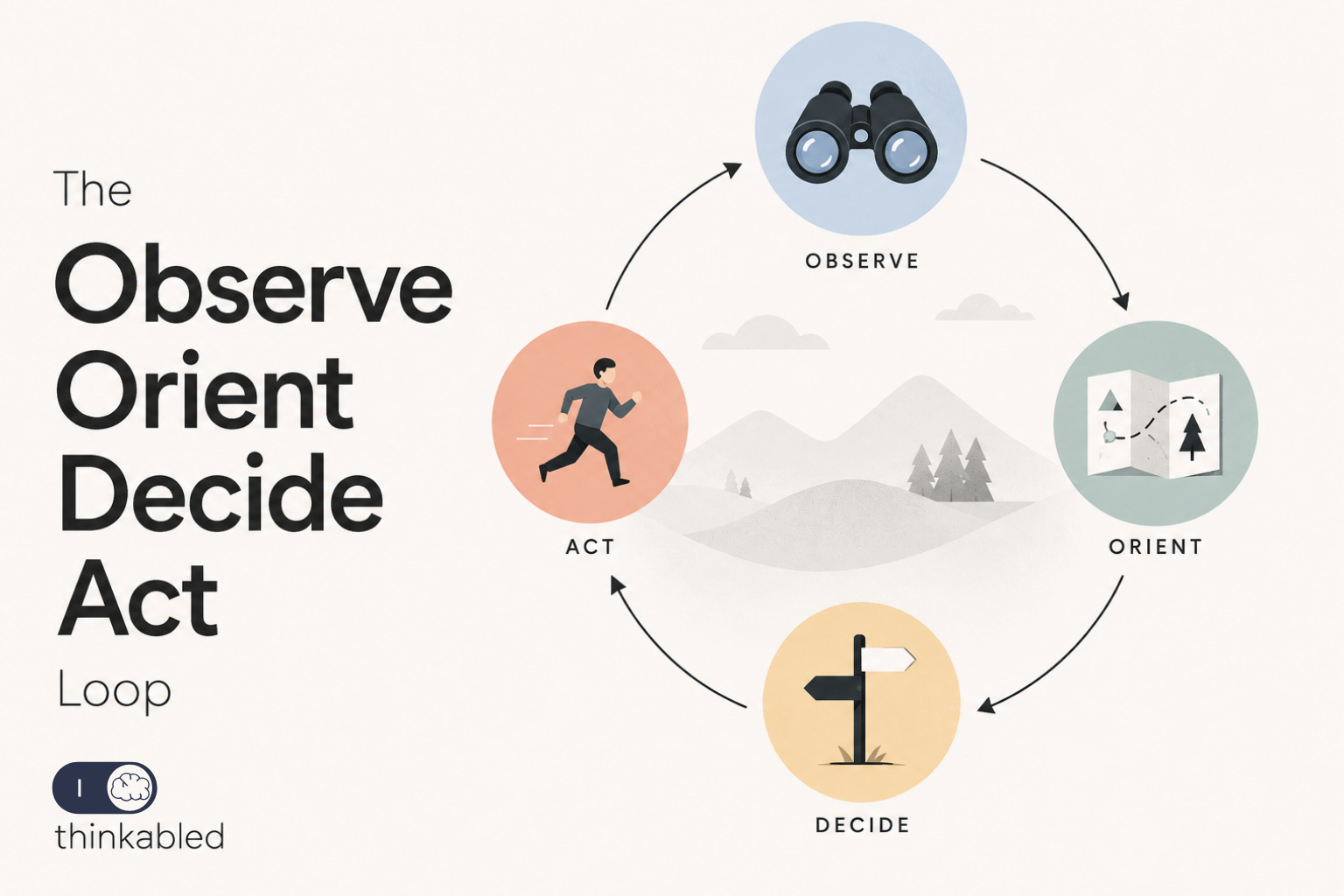
The OODA Loop is a decision-making framework developed by U.S. Air Force Colonel John Boyd in the 1970s. OODA stands for Observe, Orient, Decide, and Act — the four stages any agent moves through when responding to a changing environment. Boyd originally developed the framework to explain aerial combat dynamics, but it has since been adopted widely in business strategy, emergency medicine, competitive sports, and organizational leadership.
The framework’s central claim is not that these four stages exist — every person cycles through some version of them constantly. The insight is that the agent who cycles through them faster wins, even against an opponent with superior resources or information. Boyd called this “getting inside your opponent’s decision cycle.” If you can complete an observation-to-action loop before your opponent has finished deciding, their decision becomes irrelevant. They are always reacting to a situation that has already changed.
Stage 1: Observe — Taking In Unfiltered Reality
The first stage is the most intuitive, and the one most people assume they’re already doing well.
To observe, in Boyd’s framework, is to collect raw data from the environment without yet interpreting it — to take in what is actually happening rather than what you expect to be happening. Boyd’s study of the Korean air data revealed a detail that most analysts had overlooked. The F-86 Sabre had a bubble canopy — a wide, wraparound windshield that gave pilots a nearly unobstructed 360-degree view of the sky around them. The MiG-15 cockpit offered a narrower field of view. That single difference meant an F-86 pilot could typically spot the MiG before the MiG pilot could spot him. A few degrees of peripheral vision. A fraction of a second’s advantage. It fed into everything that came next.
The common failure in observation is not blindness — it is assumption. Most people stop observing the moment they believe they understand the situation. But the situation keeps changing. The observation channel closes. And every decision that follows is made using a map that no longer matches the territory it was drawn from.
Stage 2: Orient — The Step That Determines Everything
Boyd called orientation the “Schwerpunkt” of the OODA Loop — the center of gravity, the stage where the loop is ultimately won or lost. It is also the stage that receives the least attention in most explanations of his work, which is almost exactly backwards from how much it deserves.
To orient is to process raw observation through the accumulated filters of experience, training, cultural tradition, and mental models. Two people can observe identical facts and arrive at completely different orientations. A veteran trauma surgeon and a first-year resident can look at the same scan and see different things — not because the image differs, but because the machinery they use to interpret it differs. The surgeon’s years of exposure to similar cases shape what they notice, what they discard, and what they immediately recognize as urgent. The resident sees the same pixels and draws a different conclusion.
Boyd identified five inputs that shape orientation: genetic heritage, cultural traditions, previous experiences, new information from the observation stage, and the capacity to analyze and synthesize. Every person’s orientation is a composite of these forces, and no two composites are identical. This is what explains why expertise doesn’t just make you faster — it makes you qualitatively different as a decision-maker. An experienced chess player doesn’t process more squares than a beginner. They see patterns — configurations that carry meaning instantly because their orientation has been trained to recognize them.
What this means in practice is that improving the quality of decisions is not primarily about collecting more information. It is about improving the machinery through which information is interpreted. The sharpest observers in the room still lose if their orientation is poor. They will see the facts and draw the wrong conclusions, efficiently and confidently.
The quality of your decisions is determined less by the information you have than by the mental models through which you interpret it.
Stage 3: Decide — The Hypothesis, Not the Verdict
Most people treat a decision as a conclusion. Boyd treated it as a hypothesis.
To decide, in the OODA framework, is to select the action most likely to work given the current orientation. This phrasing is important, because “most likely to work” is different from “guaranteed to work.” The decision is a bet. It is the best available answer to an incomplete question, made at the moment when waiting further would cost more than the additional information would be worth.
The mistake most decision-makers make is holding the decide stage too long. They treat the absence of certainty as a reason to gather more observation and refine orientation further. But the loop is not designed to produce certainty. No loop is. It is designed to produce timely, directional action — action that generates new information and feeds it back into the beginning of the cycle. Boyd’s pilots understood this in the cockpit, where the cost of hesitation was physical and immediate. The lesson scales further than aviation. In any competitive environment — a business negotiation, a product launch, a hiring decision — the person who decides on imperfect information and acts often outperforms the person still waiting for perfect information. The loop rewards movement.
Stage 4: Act — Speed as Intelligence
Action is where the loop closes, and where it begins again.
The purpose of acting is not simply to produce an outcome. It is to generate new data. Every action taken produces a signal: the environment responds, the opponent reacts, circumstances shift. That signal immediately becomes new raw material for the Observe stage. The loop continues. A fast OODA cycle does not merely mean faster individual actions — it means faster learning. A pilot who cycles through Observe, Orient, Decide, and Act three times in the span that a slower pilot cycles through once has three rounds of feedback, three opportunities to refine orientation, three improved inputs into the next decision.
The hydraulic controls of the F-86 gave American pilots a mechanical advantage precisely here. Their physical inputs translated into aircraft movement faster, which meant their next position was harder for the MiG pilot to predict. The F-86 pilot had already finished acting — and was already back in the Observe stage — while the MiG pilot was still calculating a response to the previous move.
Speed in the action stage is not about carelessness or impulsiveness. It is about reducing the delay between intention and execution. Any friction in that gap — unclear authority, bureaucratic approval chains, self-doubt, poor coordination — slows the cycle without improving the quality of orientation. It costs more than it contributes.
Why Faster Cycles Beat Better Information
The counterintuitive core of Boyd’s work is this: you do not need to be smarter, better-resourced, or more comprehensively informed than your opponent. You need to complete your decision cycle before they complete theirs.
If you can observe, orient, decide, and act while your opponent is still orienting, your action creates a new reality. By the time they decide, the situation your action changed is no longer the situation they analyzed. Their careful reasoning becomes worthless — not because it was poor reasoning, but because it was reasoning about conditions that no longer exist. Boyd described this as “operating inside the opponent’s decision loop.” It is a structural advantage, not a talent advantage, and it compounds. Each cycle completed faster widens the gap, because the feedback from your actions keeps changing the conditions your opponent is trying to analyze.
This is why the OODA Loop has traveled so far from its origins in Korean airspace. The company that iterates faster than its competitors — that ships, receives feedback, adjusts, and ships again in the time a competitor spends perfecting a launch — rarely loses the long game. The principle behind the Lean Startup methodology, whatever language it uses, is fundamentally a compressed OODA cycle applied to product development. The goal is not the perfect release. It is the next loop.
How to Apply the OODA Loop
The most practical application of Boyd’s framework is not to memorize four words. It is to identify which of the four stages is your personal or organizational bottleneck.
Most people do not lose at the Observe stage. Observation is abundant. The world offers more data than any person can process, and most professional environments include reliable channels for collecting it. The bottleneck is almost always orientation. The question worth sitting with is not “Am I seeing enough?” but “Is my mental model accurate enough to interpret what I’m seeing correctly?”
Investing in orientation means deliberately building better mental models — reading widely outside your professional field, seeking out disconfirming information, reviewing past decisions after the fact to understand where orientation failed, and exposing yourself to perspectives your current mental model would naturally filter out. Boyd spent years reading across disciplines: thermodynamics, evolutionary biology, military history, cognitive psychology, and the philosophy of science. He was not collecting interesting trivia. He was sharpening the machinery through which he interpreted events. The breadth was the point.
The second application is to reduce friction in the Decide and Act stages. Most organizational systems are built, implicitly, to slow decisions down — to require consensus, escalation, and approval at multiple levels. Some of that structure is legitimate and necessary. But any process that slows the cycle without improving the quality of orientation is a liability dressed as prudence. Map where the delays are. Ask honestly whether each one improves the decision or merely delays it.
The third application is the one that changes the texture of daily life most noticeably: treat action as information rather than as a final answer. Most people act and then wait for a result, as though the loop ends at Act. Boyd’s pilots acted and immediately returned to observing. The shift in posture — from “I acted, now I wait” to “I acted, now I watch” — keeps the loop moving, keeps feedback flowing, and keeps orientation current for the next cycle.
The Slowest Person in the Room Is Not the One With the Least Information
John Boyd retired from the Air Force in 1975 and spent the next two decades developing his ideas into a comprehensive theory of conflict, strategy, and adaptive thinking. He gave lectures — sometimes running 14 hours across multiple sessions — that he called “A Discourse on Winning and Losing.” He never published a book. Almost everything he understood lives in the briefings he left behind and in the accounts of those who heard him in person.
What Boyd had seen in the Korea data, and spent the rest of his career articulating, was that advantage does not reliably belong to the stronger, faster, or better-equipped party. It belongs to the party that has learned to observe clearly, orient accurately, decide provisionally, and act quickly — and to repeat that cycle faster than the person across from them.
The OODA Loop is not a process for making perfect decisions. Nothing is. It is a framework for understanding why certain people and organizations always seem one step ahead — not because they know more, but because they move through reality at a different speed. They are not waiting for certainty that will never arrive. They are already on the next loop.
The person who wins is rarely the most informed. They are the most oriented — and the fastest to act on it.