


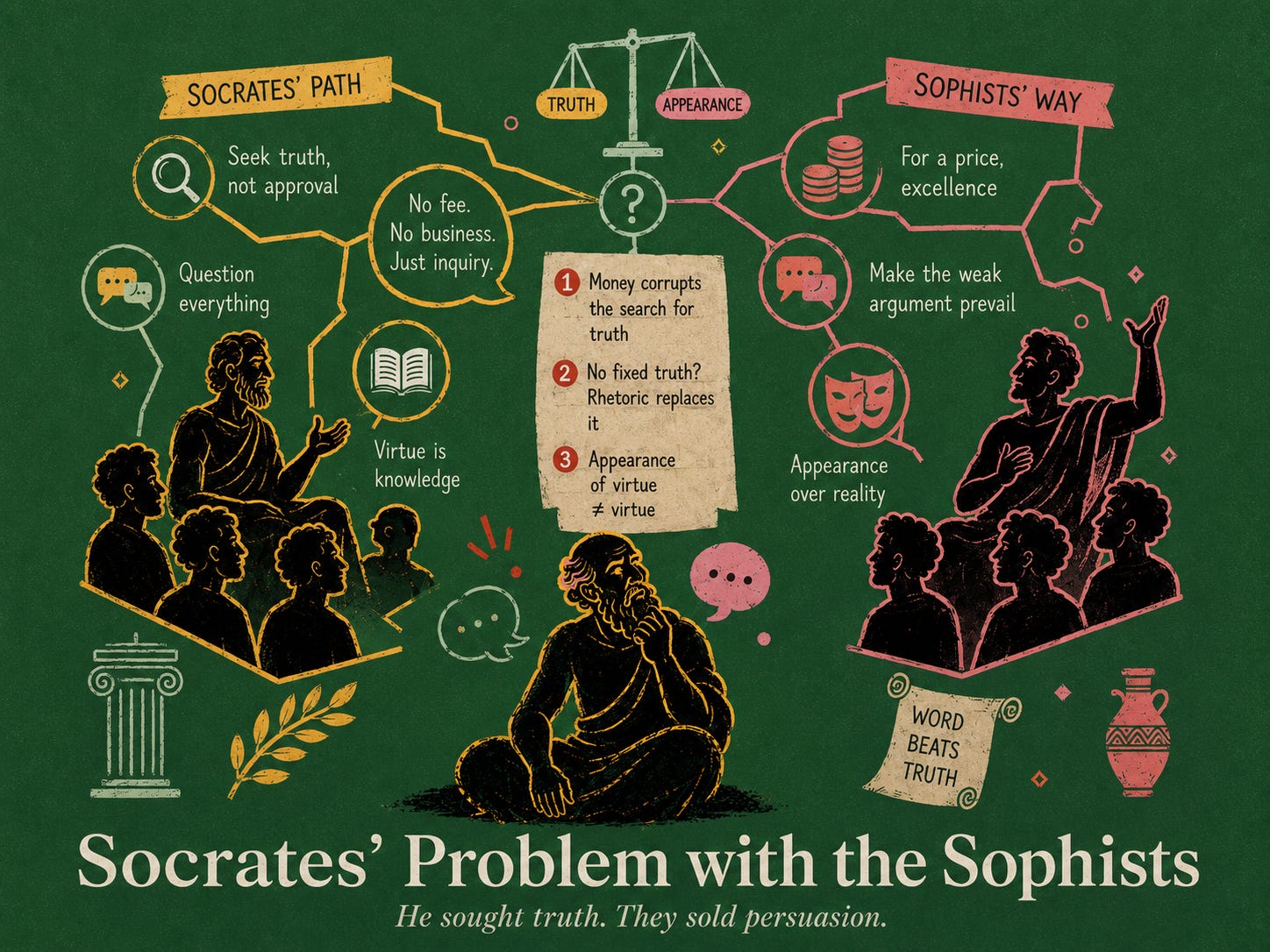
Socrates spent a good part of his life being mistaken for a sophist. Aristophanes mocked him as one in The Clouds, hanging him in a basket and having him teach young men how to argue their way out of debt. It stung enough that Socrates addressed it directly in his defense speech, decades later, standing trial for his life. That confusion is worth sitting with, because Socrates and the sophists looked, from a distance, like they were doing the same thing: standing in the Athenian agora, talking to young men, unsettling their assumptions. Up close, they were doing almost opposite things.
The sophists — Protagoras, Gorgias, Hippias, a dozen others who moved between cities charging fees — were professional teachers of rhetoric. For a price, they’d train a young Athenian to speak persuasively in the assembly or the law courts, and they billed this as teaching arete, excellence, the whole art of being a capable citizen. Protagoras claimed he could make a weak argument prevail over a strong one. Gorgias built entire speeches around the idea that speech itself, not truth, is what moves people. That’s not a caricature; it’s close to what Gorgias says himself in Plato’s dialogue named after him.
Here’s Socrates’ actual complaint, and it has three parts.
First, the money. Socrates thought charging a fee for wisdom was almost a contradiction in terms. If you claim to teach virtue and you’re doing it as a business, your incentive shifts from finding what’s true to giving customers what they want to hear. He says this plainly in the Apology — he never took payment, never ran a school with tuition, and treated the comparison to sophists like Gorgias or Prodicus as an insult he needed to correct on the record.
Second, and more serious: the sophists didn’t seem to believe there was a fixed truth to arrive at. Protagoras’s famous line — “man is the measure of all things” — meant that what’s true or good is relative to whoever’s judging it. If that’s right, then rhetoric isn’t a shortcut to truth; it’s a replacement for it, because there’s no destination underneath the persuasion. Socrates couldn’t accept this. His whole method, the elenchus — cross-examining someone’s beliefs until the contradictions surface — only makes sense if there’s something stable being circled. You don’t refute a man’s definition of courage unless you think courage has a nature independent of his opinion about it. Take that assumption away and Socrates is just another guy arguing for sport, which is exactly what his critics accused him of being.
Third: the sophists taught the appearance of virtue rather than virtue itself. This is the charge Plato dramatizes over and over — Thrasymachus in the Republic, barking that justice is just the advantage of the stronger; Euthydemus and his brother, turning philosophical argument into a parlor trick, tripping people up with wordplay for its own sake and calling it wisdom. Socrates’ response wasn’t “you’re wrong about justice,” full stop. It was closer to: you haven’t earned the right to talk about justice yet, because you’ve never sat with the question of what it actually is. Knowledge, for Socrates, wasn’t a technique you could pick up and deploy. It was something you had to be changed by.
None of this means the sophists were charlatans with nothing to offer — Protagoras clearly had a serious position on the relativity of perception, and Gorgias’s rhetoric shaped how an entire civic culture argued with itself. Socrates respected some of them enough to spend whole dialogues taking their positions seriously, which is more than he did for people he actually thought were beneath argument. But respect isn’t agreement. He thought a teacher who trains you to win arguments without caring whether your conclusions are true has handed you a weapon, not an education. And weapons, in the hands of ambitious young Athenians who’d go on to run the assembly and the courts, do damage.
Which is, in the end, the uncomfortable irony of his trial. He was executed on charges that sounded exactly like what a sophist would be accused of — corrupting the youth, making the worse argument the better. The jury never quite worked out the difference he’d spent his whole life insisting on.