


Your team is degrading right now, and you might not even see it.
Not because people are failing. Not because your strategy is wrong. Not because you’re growing too fast or too slow.
Six months ago, work flowed. Today, it stutters. Decisions that used to take one conversation now take three meetings. Roles that were obvious have become ambiguous. The rhythm you once had has dissolved into constant friction.
This is what organizational decay looks like from the inside. And it happens to everyone—startups and enterprises, growing teams and stable ones, brilliant founders and experienced executives.
The question isn’t whether this is happening to you. It is.
The question is whether you’ll recognize it in time to fight back.
Why This Happens: The Physics of Organizational Decay
What you’re experiencing has a name: entropy.
And it’s not a business term—it’s a law of physics.
Entropy is the principle that all systems, left alone, naturally move from order to disorder.
Disorder is the default state of everything. Your organization is no different.
What Exactly Is Entropy?
In physics, entropy is the measure of disorder or randomness in a system. The Second Law of Thermodynamics states that in an isolated system, disorder always increases over time unless work is done to maintain order: ΔS ≥ 0
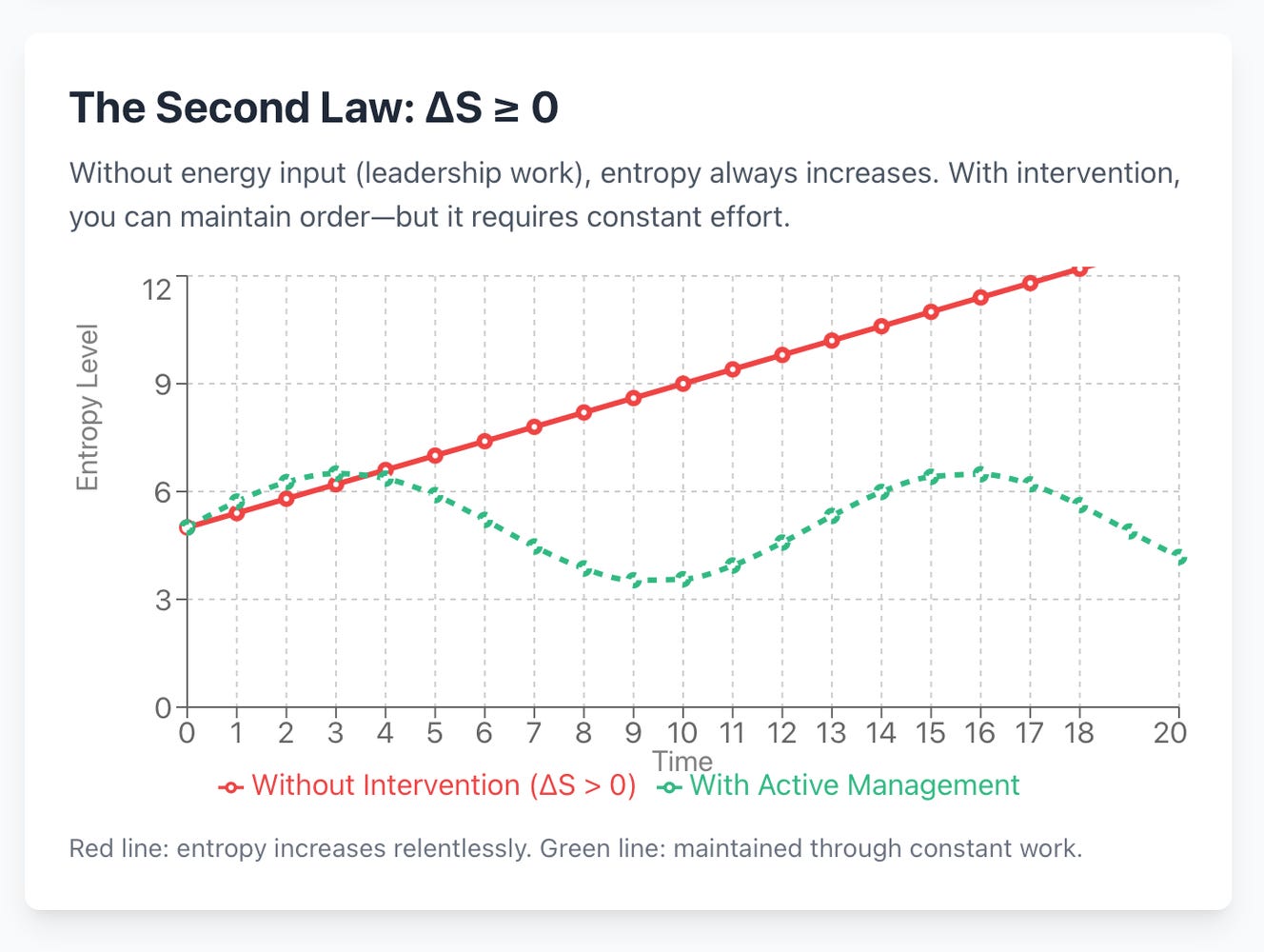
Entropy is everywhere. Entropy drives the universe.
It’s the invisible gravity pulling all systems toward disorder.
It’s why your coffee cools.
It’s why your room becomes messy unless you intentionally clean it.
It’s why your body weakens unless you deliberately train it.
Your organization is no different. The Law of Organizational Entropy dictates that roles and responsibilities will drift toward sameness and confusion unless acted upon by an opposing force.
Clear processes decay into confusion.
Simple communication becomes cluttered.
Strong cultures drift into complacency.
High standards soften into average habits.
Entropy is the default. Order is the exception.
Entropy doesn’t care about your talent, your funding, or your ambitions. It just works. Constantly. Invisibly. Pulling every system—including yours—toward chaos.
The only thing that stops it is deliberate, continuous effort to push back.
What Is Organizational Entropy?
Organizational entropy is the gradual decline of structure and efficiency in a company or team. It shows up as:
Decision fatigue — nobody knows who decides what.
Process drift — people no longer follow the original system.
Cultural dilution — new habits override the values that once made the team strong.
Information noise — everyone is busy but not aligned.
Reactive work — constant fire-fighting instead of intentional focus.
Entropy is the price you pay for not maintaining order.
Entropy Doesn’t Announce Itself. You won’t see entropy coming. There’s no single moment when chaos arrives.
Instead, you’ll notice smaller things:
Meetings that used to take 30 minutes now take an hour. Decisions that used to stick now get relitigated three times. That project everyone agreed on last week? Somehow the requirements changed again. Engineers are frustrated because priorities keep shifting. Designers are exhausted from defending work to people outside their discipline. Managers spend more time managing conflict than making progress.
Everyone is working harder. Nothing is moving faster.
This is what entropy looks like in organizations. Not a explosion, but a slow thickening—like trying to run through water that gets deeper every week.
Why Does Organizational Entropy Happen?
An organization is an open system. It constantly exchanges energy and information with its environment. While open systems can import energy to create temporary order, the underlying tendency toward entropy still applies unless that order is actively maintained.
Every time you hire someone, you’re adding particles to the system. Every new project introduces complexity. Every decision creates branches. Every communication adds noise. The number of possible states your organization can be in grows exponentially.
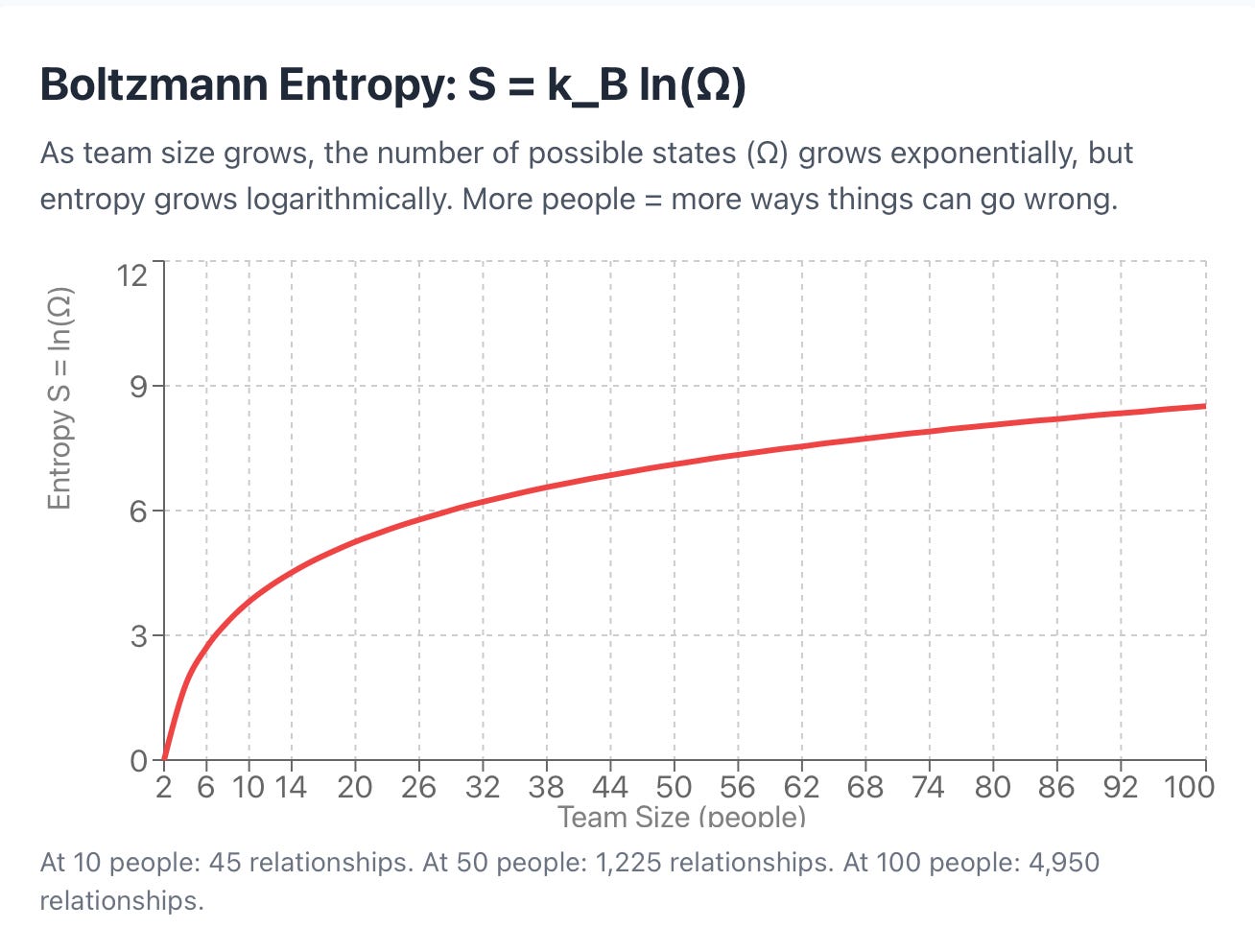
Physics gives us a useful analogy. Boltzmann’s formula, S = kᵦ ln(Ω), defines entropy (S) as the natural logarithm of the number of possible states (Ω) a system can occupy. The more ways your system can be configured, the higher the entropy.
For organizations, this is brutal: at ten people, there are 45 possible two-person relationships. At fifty people, there are 1,225. At five hundred, there are 124,750. Each relationship is a possible state where information can degrade.
As Ω grows exponentially, entropy grows logarithmically with it.This is why small teams feel tight and large organizations feel bureaucratic. It’s not a failure of leadership. It’s mathematics.
Organizational entropy is not about laziness or incompetence. It is a systemic property—the “rust” on the machinery of your company. If you do not actively maintain the system, it will naturally degrade into several destructive states:
• Paralysis through Politeness: No one feels empowered to make a decision because they don’t want to step on a colleague’s toes.
• Chaos through Collision: Multiple people try to make the same decision in opposite directions.
• Information Fragmentation: Communication channels get clogged with “noise,” and critical knowledge is lost.
Left unchecked, this entropy slows decision-making, kills innovation, and drains employee morale. To survive, you must move from entropy reduction to entropy management.
Because humans prefer comfort over clarity.
Because systems age. Because teams grow.
Because priorities shift.
Because information spreads faster than alignment.
And unless someone actively maintains structure, entropy wins.
The Forms of Organizational Entropy
Entropy shows up in predictable ways:
Information entropy. Knowledge that once lived in one person’s head now needs to spread across fifty people. Each transmission loses fidelity. Context disappears. Nuance evaporates. Critical details become garbled telephone game messages. Eventually, nobody has the complete picture—just fragments that don’t quite fit together.
Process entropy. You design a workflow that’s elegant and efficient. Then someone needs an exception for a client emergency. Then another for a compliance requirement. Then another because Bob’s on vacation. Each exception makes sense in isolation, but collectively they transform your clean process into a maze of special cases that nobody fully understands.
Decision entropy. Early on, decisions are fast because authority is clear. As you grow, decision-making diffuses across more people. Each person needs context. Each person has questions. Each person wants input. What took one conversation now takes three meetings, five Slack threads, and two follow-up emails. Energy that should drive progress gets dispersed into coordination overhead.
Cultural entropy. You start with a strong culture because the founders exemplify it daily. But culture isn’t written down—it’s demonstrated. As you scale, new people learn culture from whoever trains them, who learned it from whoever trained them. Each generation is a photocopy of a photocopy. The signal degrades. The culture drifts. What you measure stays strong; everything else becomes noise.
Why Entropy Always Increases
Entropy always increases over time: dS/dt ≥ 0. This is the rate equation, and it’s relentless.
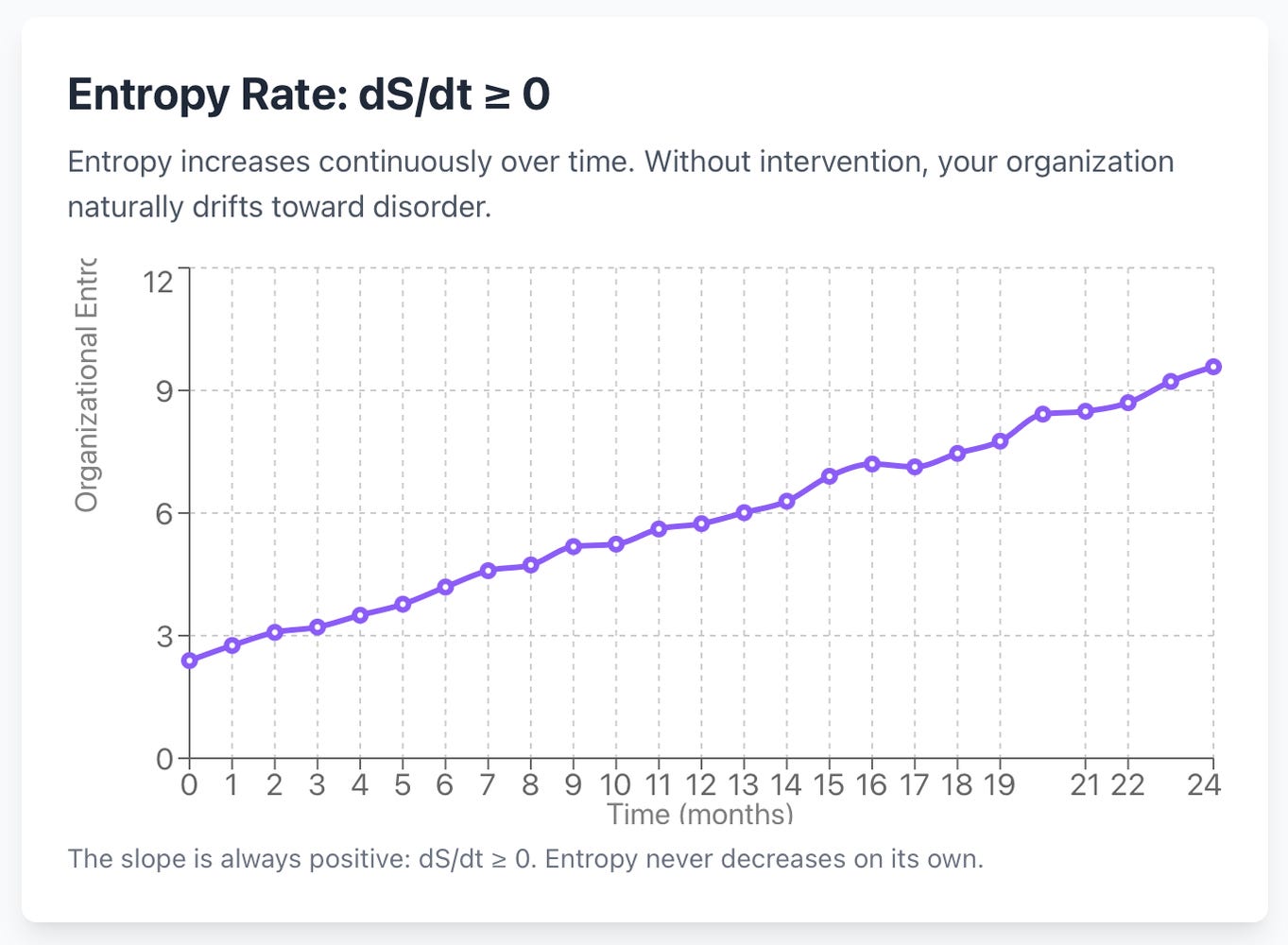
Why? Because there are vastly more ways for things to be disorganized than organized.
Imagine a deck of cards: there’s exactly one way for it to be perfectly ordered by suit and rank, but 52! (that’s 8 × 10⁶⁷) ways for it to be shuffled.
Any random change is almost certain to move you toward disorder simply because disordered states outnumber ordered ones by astronomical margins.
In organizations, the math is identical. There are millions of ways for responsibilities to be unclear, priorities to conflict, and processes to drift—but only a handful of configurations where everything is aligned and efficient.
Random drift will almost always increase entropy. This isn’t pessimism. It’s just how systems work. Three properties of organizations guarantee entropy growth:
Scale increases states. The more people, projects, and processes you have, the more ways your system can be configured. Most of those configurations are disordered. Only a tiny fraction represent the organized, efficient state you want. Random drift will almost always move you toward disorder simply because there are exponentially more disordered states than ordered ones.
Energy dissipates. The intense focus and energy that launches a startup or project doesn’t sustain itself. People get tired. Priorities shift. Attention scatters. Without constant input of energy to maintain structure, the system relaxes into a lower-energy, higher-entropy state—which looks like complacency, confusion, and drift.
Memory degrades. Systems don’t remember why decisions were made unless you actively preserve that memory. The brilliant rationale behind your process disappears when the person who designed it leaves. Future employees see only the process, not the reasoning. They work around it or ignore it because they don’t understand what problem it solved. Institutional knowledge evaporates, and with it, the coherence of your system.
The Thermodynamics of Management
Here’s the uncomfortable implication: maintaining order requires continuous work.
In physics, you can only decrease entropy locally by increasing it elsewhere. Your refrigerator makes food cold (low entropy) by dumping heat into your kitchen (high entropy). The total entropy of the system still increases.
Organizations work the same way. You can create pockets of order—a well-run team, a clean process, a clear strategy—but only by expending energy. That energy has to come from somewhere. Usually from leadership.
This is why leadership is exhausting. You’re not just making decisions. You’re fighting entropy. You’re constantly pulling the organization back toward structure when physics is pulling it toward disorder.
High-leverage interventions reduce entropy efficiently. Writing down a decision so fifty people don’t have to ask. Creating a template that standardizes communication. Defining ownership so confusion doesn’t spread. These are local decreases in entropy that cost you energy once but save collective energy repeatedly.
Low-leverage work burns energy without reducing entropy. Answering the same question twelve times instead of writing it down. Attending meetings that could be emails. Reviewing work that should have been delegated. This is fighting entropy inefficiently—using energy that could be maintaining order to simply keep up with disorder.
The teams that scale are the ones that figure out how to fight entropy efficiently.
The Antidote to Organizational Entropy
You don’t eliminate entropy. You manage it—like brushing your teeth or maintaining a garden. You can only fight it—every day, deliberately, systematically.
The fight against entropy isn’t a one-time effort. You can’t reorganize once and declare victory. You can’t clarify roles in an offsite and assume they’ll stay clear.
The Work Nobody Celebrates. Fighting entropy isn’t glamorous. It’s not the work that gets featured in case studies or wins awards.
It’s saying “no” to the smart person with the valid concern who wants to join a meeting they don’t need to be in.
It’s redrawing boundaries that keep getting crossed because “we’re all just trying to help.”
It’s having the same conversation about who owns what for the fifteenth time because organizational memory lasts about six weeks.
It’s killing the meeting that no longer serves a purpose but everyone keeps attending out of habit.
It’s documentation. Repetition. Reinforcement. Maintenance.
Nobody wakes up inspired to “maintain organizational clarity.” Nobody’s mission statement is “fight entropy.” Nobody’s LinkedIn headline says “professional chaos preventer.”
But this unglamorous work is what separates functional organizations from dysfunctional ones. Thriving companies from dying ones. Teams that scale from teams that collapse under their own weight.
The good news: decades of management science have produced specific tools designed to fight organizational disorder. Here’s how to deploy them:
Create Energy Gradients Through Accountability Frameworks
In thermodynamics, order emerges where there are energy differences. In organizations, clarity creates gradients. When roles are sharply defined, when ownership is explicit, when standards are high, you create a structure that channels energy productively rather than letting it dissipate into confusion.
Shopify’s “GSD” (Get Shit Done) framework assigns exactly one person as the owner of every outcome. Not a team. One name. This creates a sharp gradient: one person feels the full weight of accountability, which concentrates their energy. Everyone else knows exactly where to direct questions, which prevents energy from dispersing across ambiguous ownership.
RACI Matrix (Responsible, Accountable, Consulted, Informed). This deceptively simple tool reduces entropy by eliminating the most common source of organizational disorder: unclear ownership. For every decision or process, you explicitly map who is Responsible for execution, who is Accountable for outcomes, who must be Consulted, and who needs to be Informed.
The entropy reduction is mathematical. Without RACI, a team of ten people might have 45 possible ownership configurations for any given decision. With RACI, there’s exactly one. You’ve collapsed the state space from dozens of possibilities to one defined state.
OKRs (Objectives and Key Results). Google’s adoption of OKRs isn’t just goal-setting—it’s entropy management through focus. By limiting each team to 3-5 objectives with 3-5 measurable key results each, you create bounded state space. Teams can’t drift in infinite directions because success is precisely defined. The system becomes ordered around specific outcomes rather than diffusing energy across vague intentions.
The power is in the constraint: most organizations fail with OKRs by creating too many objectives, which paradoxically increases entropy by expanding the number of possible states the organization can occupy.
Reduce Available States Through Process Maturity
The more ways your system can be configured, the more entropy increases. Process maturity frameworks systematically reduce this variability.
Amazon’s “two-pizza teams” rule limits team size, which limits communication overhead, which limits the possible disordered states. Their “single-threaded leadership” rule means each leader owns one major initiative, not three, which reduces cognitive load and prevents attention from scattering.
Constraints aren’t restrictions—they’re entropy management.
CMMI (Capability Maturity Model Integration). Originally developed for software but applicable broadly, CMMI provides a five-level framework for process maturity:
Level 1 (Initial): Processes are unpredictable and reactive. Maximum entropy—every situation is handled differently.
Level 2 (Managed): Projects are planned and tracked. Entropy reduces as repeatability emerges.
Level 3 (Defined): Processes are standardized across the organization. Major entropy reduction through consistency.
Level 4 (Quantitatively Managed): Processes are measured and controlled. Entropy is not just reduced but monitored.
Level 5 (Optimizing): Continuous improvement becomes systematic. The organization fights entropy proactively rather than reactively.
Each level represents a phase transition to lower entropy. The progression from chaos (Level 1) to optimization (Level 5) is literally a progression toward lower organizational entropy.
Six Sigma and Process Capability Indices (Cp/Cpk). Six Sigma attacks entropy through variance reduction. The Process Capability Index measures how much variation exists in a process relative to specification limits. A Cpk of 2.0 means your process has very low variation—low entropy. A Cpk of 0.5 means high variation—high entropy.
When Motorola pioneered Six Sigma, they weren’t just improving quality. They were systematically reducing process entropy. Every “defect” is a manifestation of disorder—an unexpected state the system shouldn’t occupy. By driving toward 3.4 defects per million opportunities, you’re creating an extraordinarily low-entropy system where outcomes are highly predictable.
Build Dissipative Structures Through Knowledge Management
In physics, dissipative structures maintain order by continuously exchanging energy with their environment. A whirlpool is a dissipative structure—it maintains its shape by continuously flowing water through it. Stop the flow, and the structure disappears.
Organizations need the same: structures that maintain order through continuous flow. Daily standups that surface blockers before they metastasize. Weekly retrospectives that catch process decay. Quarterly strategy reviews that realign on what matters. These aren’t bureaucracy—they’re dissipative structures that maintain order by continuously cycling information through the system.
The Balanced Scorecard. Kaplan and Norton’s framework isn’t just strategy measurement—it’s an entropy-fighting dissipative structure. By tracking four perspectives (Financial, Customer, Internal Processes, Learning and Growth) simultaneously and linking them causally, you create a continuous feedback loop that prevents entropy in any one dimension.
Most organizations let entropy accumulate invisibly until a crisis forces attention. The Balanced Scorecard makes entropy visible through leading indicators. When internal process metrics decline, you see it before financial results collapse. The continuous measurement and review cycle is the “flow” that maintains organizational structure.
Knowledge Management Systems (SECI Model). Nonaka and Takeuchi’s SECI framework addresses information entropy directly: Socialization (tacit to tacit), Externalization (tacit to explicit), Combination (explicit to explicit), and Internalization (explicit to tacit).
The most dangerous form of organizational entropy is knowledge trapped in individuals’ heads. When that person leaves, entropy spikes catastrophically. The SECI model provides a systematic way to convert private knowledge into shared knowledge, reducing the system’s dependence on any single particle (person).
Companies like Toyota use this rigorously. Their “A3 thinking” process forces knowledge externalization—every problem-solving process must be documented on a single A3-sized sheet. This converts tacit problem-solving knowledge into explicit, transferable knowledge. When the expert retires, the knowledge remains. Entropy is contained.
Communities of Practice (CoPs). Etienne Wenger’s framework creates dissipative structures for knowledge flow. A CoP is a group of people who share a concern or passion and learn together through regular interaction. This continuous interaction prevents knowledge entropy—expertise doesn’t calcify in silos but flows through the organization.
Xerox famously discovered their copier repair technicians were more effective when they regularly shared war stories over breakfast than when following official documentation. The breakfast meetings were dissipative structures that maintained collective knowledge order through continuous information exchange.
Measure and Monitor Entropy Directly
What gets measured gets managed. Several frameworks make entropy visible:
Technical Debt Metrics. In software, technical debt is literal code entropy—shortcuts that increase disorder. Tools like SonarQube measure code complexity, duplication, and maintainability. These are direct entropy measurements. When cyclomatic complexity increases, you’re watching entropy grow in real-time.
Smart organizations track technical debt as a KPI, not just a developer complaint. They allocate 15-20% of engineering time to debt reduction because they understand entropy doesn’t reduce itself.
The Spotify Health Check Model. Spotify’s squads regularly rate themselves across dimensions like “easy to release,” “suitable process,” “tech quality,” and “mission clarity.” This is entropy monitoring. When scores decline, you’re seeing entropy accumulate before it causes failure.
The model creates a dissipative structure—regular measurement and discussion prevents entropy from accumulating invisibly. Problems surface while they’re still manageable.
Organizational Network Analysis (ONA). Tools that map communication patterns reveal information entropy. If critical knowledge flows only through three people, you have high entropy risk—those three people are single points of failure. ONA makes this visible so you can create redundancy and reduce entropy.
Increase System Openness Through Learning Systems
Closed systems inevitably die. They run out of free energy and collapse into maximum entropy—heat death. Organizations avoid this by being open systems that pull in new energy from their environment.
The Learning Organization (Senge’s Five Disciplines). Peter Senge’s framework is explicitly designed to prevent organizational entropy through openness:
Systems Thinking: Understanding interconnections prevents local optimization that increases global entropy
Personal Mastery: Individual growth brings new energy into the system
Mental Models: Challenging assumptions prevents cognitive entropy
Shared Vision: Alignment reduces the state space of possible directions
Team Learning: Collective insight prevents knowledge entropy
After Action Reviews (AARs). The U.S. Army’s AAR process is a dissipative structure for learning. After every operation, teams answer four questions: What was supposed to happen? What actually happened? Why was there a difference? What will we do differently? This continuous learning cycle prevents the accumulation of failure modes—each mistake becomes explicit knowledge rather than repeated disorder.
Retrospectives and Kaizen Events. Agile retrospectives and lean kaizen events serve the same function—regular opportunities to examine and reduce process entropy. The cadence matters. Weekly retrospectives catch entropy while it’s small. Annual reviews let it accumulate into organizational debt.
Reduce available states. The more ways your system can be configured, the more entropy increases. Constraints reduce available states and therefore reduce entropy.
The Four Pillars of Order
To fight the natural slide into disorder, the “Entropy-Based Proactive Control Model” suggests four mental shifts for individuals and leaders:
1. Learning Orientation: Think of your team as an “open system.” You must constantly exchange new information and skills with the environment to prevent the system from becoming a stagnant, closed loop.
2. Goal Orientation: Entropy is maximized when energy is dispersed. Clear goals act as a lens, concentrating “high-quality energy” on a single point to reduce chaos.
3. Change Orientation: Systems in perfect equilibrium eventually stall and die. You must proactively break old patterns to allow for “emergence”—the birth of new, more efficient structures.
4. Risk Taking: Reaching a more ordered state often requires passing through a “critical state” of temporary chaos. You must be willing to take calculated risks to navigate the transition.
How to Anchor Your Progress
Fighting entropy requires more than just a vision; it requires anchors built into your daily routines.
Define the “Main Branch.” In software, the “main” branch is the canonical version of the code. Organizations need the same. You must publicly define how you work—who owns code quality, who owns the customer experience, and who has the final say. This creates a safety net so that when experiments fail, the team knows how to reset to a functional state.
Create High-Leverage Anchors. When Mark Zuckerberg wanted Facebook to go “mobile-first,” his declarations weren’t enough. He finally forced the change by refusing to attend any meeting that wasn’t focused on mobile prototypes. He anchored the change in his calendar. If you want more research, make it a requirement for budget approval. If you want better collaboration, build it into the weekly standup.
The Takeaway: The Question That Matters
The question isn’t whether your organization is experiencing entropy. It is. Right now. In ways you can see and ways you can’t.
The question is whether you’re going to fight it.
Because entropy doesn’t negotiate. It doesn’t take breaks. It doesn’t wait for you to finish your strategic initiatives or hit your quarterly targets.
It’s working on your company today. It’ll be working on it tomorrow. And the day after that.
The only thing that stops it is you—deciding that maintaining order isn’t a distraction from the real work.
It is the real work.
Everything else depends on it.
Because the forces of disorder never stop. Teams grow. People change. New challenges blur old boundaries. What was obvious six months ago becomes ambiguous today.
So the work of a leader—the real work, beneath the strategy and vision and inspiration—is maintenance. It’s the constant, unglamorous act of redrawing lines that keep fading. Restating decisions that keep getting questioned. Defending clarity that keeps dissolving.
It’s not the work anyone celebrates. But it’s the work that keeps everything else from collapsing.
The desk doesn’t stay clean on its own, and neither does your organization
Keep Learning
Fighting entropy in your organization? Join 1,000+ leaders who get weekly frameworks on systems thinking, process design, and building high-performing teams. Subscribe to Cerebrate →
