


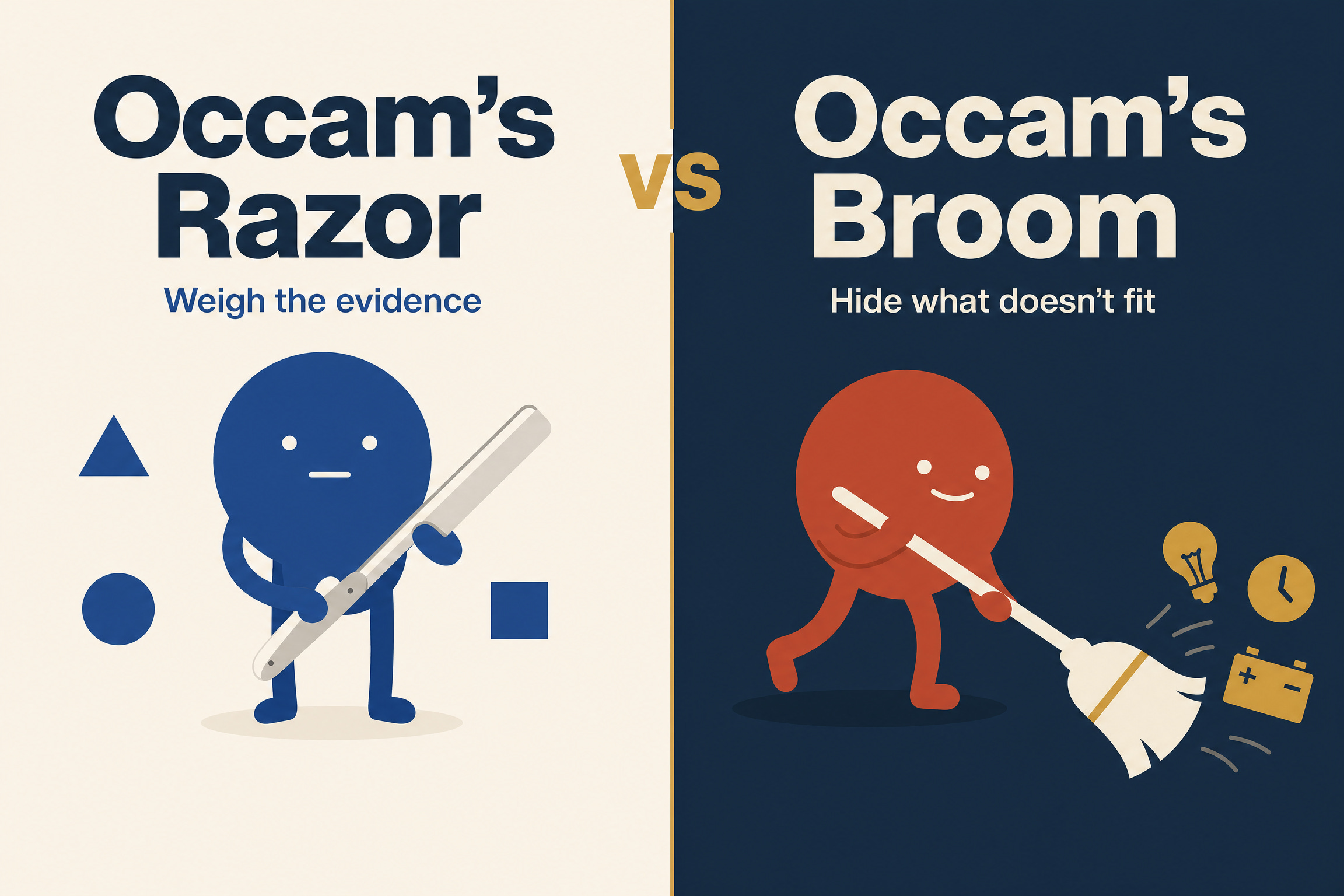
Your car won’t start. You turn the key, hear a click, nothing happens. Your first thought: dead battery. It’s the most common cause, it fits the symptoms, and you don’t need to imagine anything exotic to explain it. So you jump the battery, it starts, you drive off satisfied.
That’s Occam’s Razor working exactly as intended. Given the evidence — a click, no ignition — the simplest explanation was also the most likely one. William of Ockham, the 14th-century friar the idea is named after, put it as a rule of thumb: don’t invent extra causes when a simpler one already accounts for what you’re seeing. Every field runs on some version of this. Doctors reach for the common diagnosis before the rare one. Detectives suspect the spouse before the stranger. Simple isn’t lazy. Simple is usually correct.
Here’s the same car story, run a second time.
Your car won’t start. You hear the click, and this time you also notice the headlights are dim, the click sounds a little different than last time, and starting the car has been getting harder for a week, not sudden. Some part of you already suspects the starter motor — a real repair, a few hundred dollars, an afternoon at the shop. “Dead battery” is cheaper and faster to believe. So you don’t mention the dim headlights when you describe the problem. You don’t bring up the week of hesitation. You say “it just wouldn’t start” and let the story arrive at the tidy answer.
That’s Occam’s Broom. Same simple conclusion, same words even — but this time it was built by hiding evidence, not weighing it. Biologist Sidney Brenner coined the term for exactly this move: sweeping inconvenient facts out of the story so the explanation stays clean.
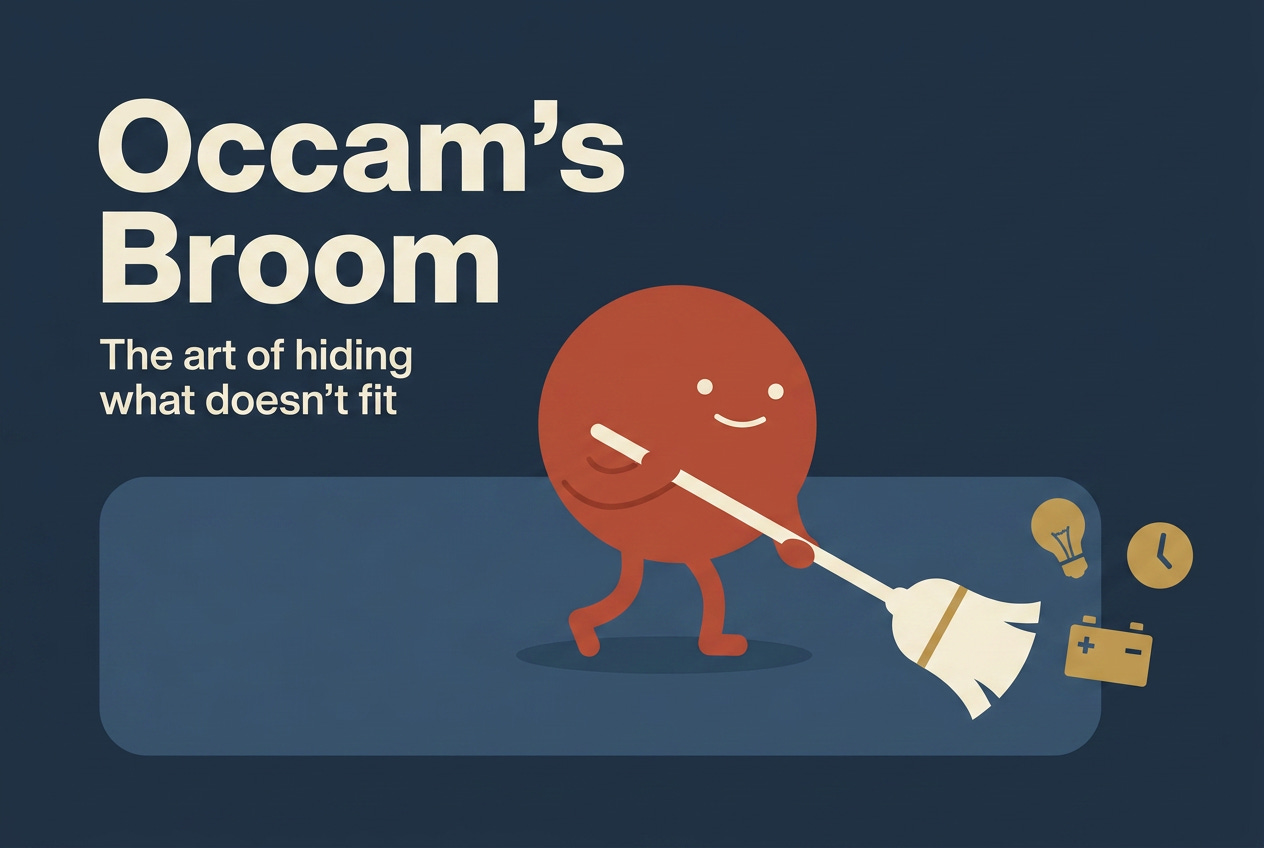
The razor and the broom produce the same-looking sentence. That’s what makes the broom dangerous — it doesn’t look like dishonesty from the outside, or even from the inside. It looks like common sense. The only difference is what happened to the facts that didn’t fit.
You’ve done this. Not with a car, maybe — with a failed plan you blamed on “bad timing” when you’d ignored three warnings first. With an argument you won because you never said the part that would have complicated it. With a diagnosis, a decision, a breakup story you’ve told so many times the inconvenient half quietly stopped being in it.
There’s one honest test for telling the two apart, and it works in any situation: before you accept a simple explanation — yours or someone else’s — ask what evidence it would have to leave out to stay that simple. If the answer is “none,” you’re holding a razor. If the answer is “quite a bit, actually,” you’re holding a broom, and someone’s been cleaning up.
Next time your car starts on the first jump, that’s the razor. Next time you’re relieved it started before you’d even checked why — that’s worth a second look.