


Most people believe habits fail because they lack motivation.
In reality, habits fail because they are poorly designed.
When a behavior feels confusing, difficult, or unrewarding, the brain naturally resists it. The solution isn’t more willpower—it’s better systems.
Small habits, repeated daily, quietly shape your future.
Why Small Habits Create Big Change
Habits are not about overnight transformation. They are about direction.
If you improve just a little each day, the results compound. What feels insignificant today becomes meaningful over time. The same way tiny financial investments grow through compound interest, habits compound into identity, confidence, and capability.
Progress is often invisible—until it isn’t.
The Habit Loop Behind Every Behavior
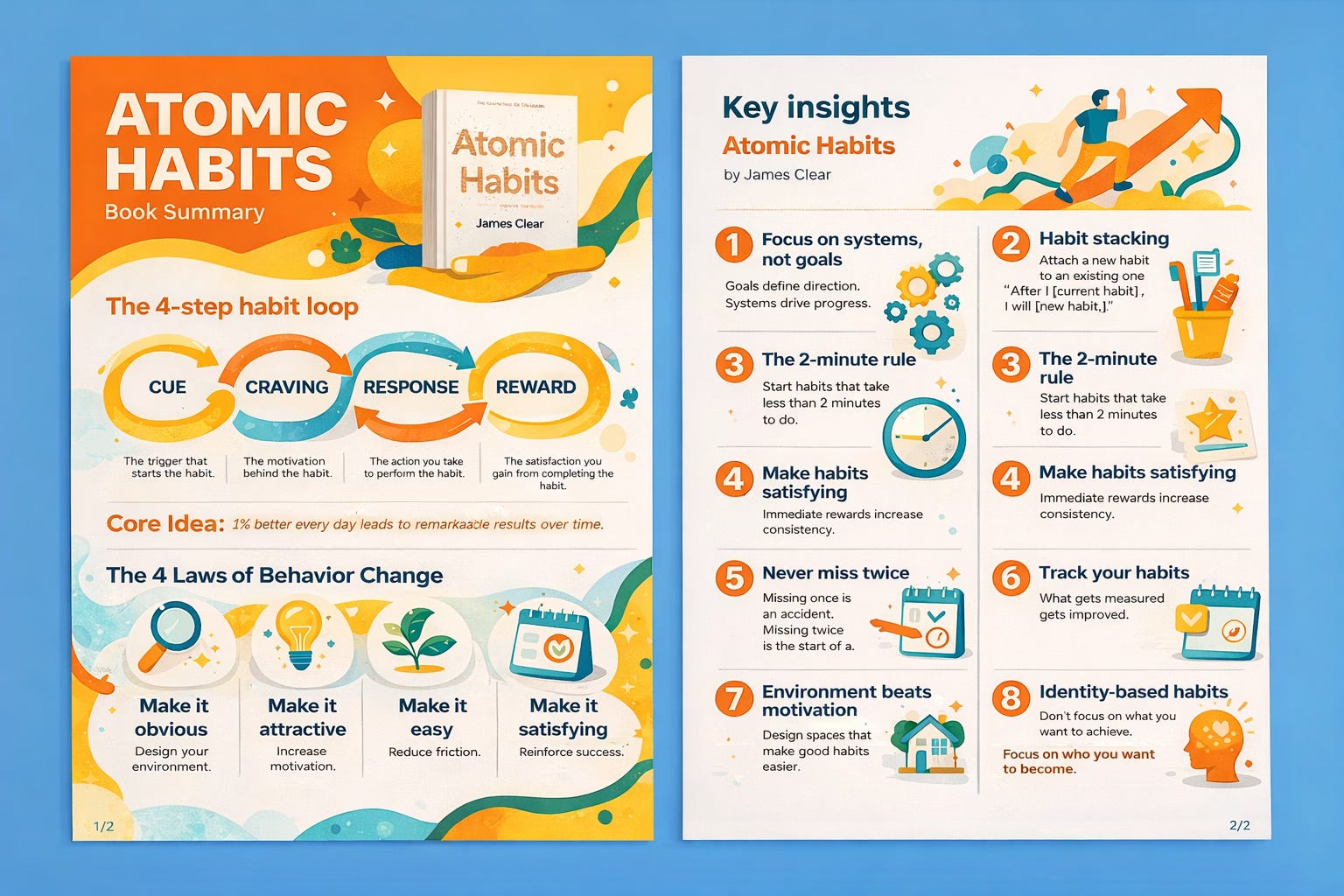
Every habit follows the same four-step loop:
Cue – A trigger that initiates the behavior
Craving – The desire for change
Response – The action you take
Reward – The benefit that reinforces the behavior
To change a habit, change one part of the loop. Make good habits easier to start and bad habits harder to continue.
Identity Comes Before Outcomes
Most people focus on what they want to achieve.
Lasting change comes from focusing on who you want to become.
Every habit is a vote for your identity. When behavior aligns with identity, consistency feels natural rather than forced.
You don’t build habits to achieve goals.
You build habits to become someone new.
Habit Stacking: The Easiest Way to Start
One of the simplest ways to build a new habit is to attach it to an existing one.
This is called habit stacking.
The formula is simple:
After I [current habit], I will [new habit].
After brushing my teeth, I will floss one tooth.
After pouring my morning coffee, I will read one page.
After opening my laptop, I will write one sentence.
Existing habits act as reliable cues. You’re not creating a new routine—you’re extending one that already exists.
The 2-Minute Rule: Make Starting Effortless
When a habit feels overwhelming, the brain delays it.
The solution is to shrink the habit.
The 2-minute rule states that any new habit should take less than two minutes to start.
“Read before bed” becomes “read one page.”
“Work out” becomes “put on gym shoes.”
“Write daily” becomes “open the document.”
The goal is not performance. The goal is showing up. Once you start, momentum often takes over.
The Goldilocks Rule: Stay Motivated Without Burnout
Habits stick when they are challenging—but not overwhelming.
This is the Goldilocks Rule: humans experience peak motivation when working on tasks that are just slightly beyond their current ability.
Too easy, and you get bored.
Too hard, and you quit.
The key is to continuously adjust difficulty so the habit stays engaging while remaining achievable.
The Four Laws of Building Better Habits
Make It Obvious
Design your environment so good habits are visible and easy to notice.
Make It Attractive
Pair habits you want to build with things you enjoy.
Make It Easy
Reduce friction. Simplify. Start smaller than you think necessary.
Make It Satisfying
Track progress, celebrate consistency, and reward effort.
Never Miss Twice
Perfection isn’t required. Consistency is.
Missing once is an accident. Missing twice is the start of a new pattern. Get back on track quickly and protect momentum.
The Power of Systems Over Time
Habits don’t change your life in a day. They change your trajectory.
When habits are small, identity-based, and supported by clear systems, improvement becomes inevitable. The most successful people aren’t extraordinary—they’re consistent.
Build habits that fit who you want to become, and let time do the rest.