


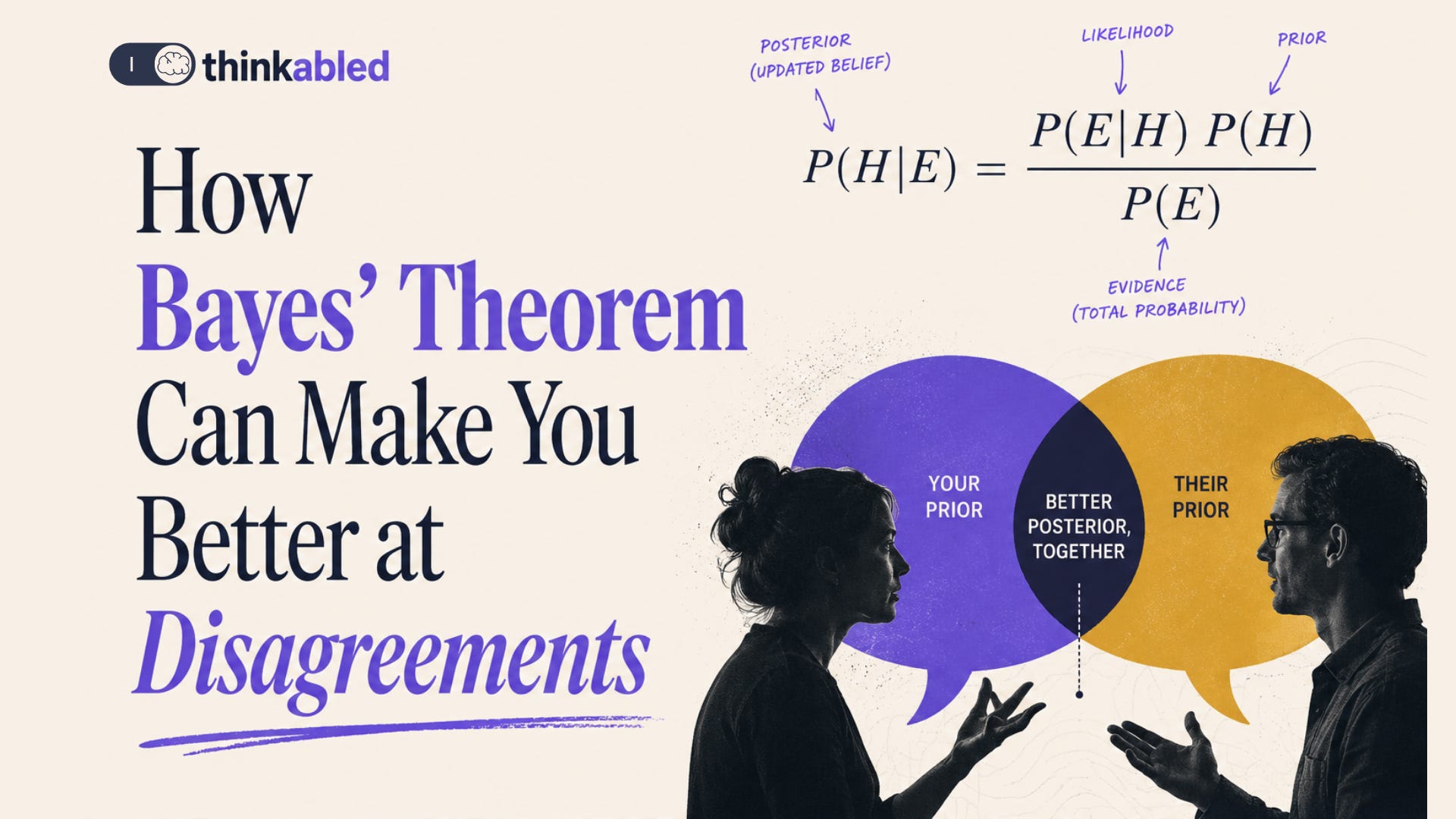
There’s a particular kind of argument most people have had. You’re debating something — a business decision, a political view, a personal choice — and halfway through, you realize neither side is actually updating. You’re not exchanging information. You’re exchanging positions. Everyone leaves more convinced than they arrived.
The problem isn’t that people care too much — it’s that caring and thinking well are different skills, and most arguments only exercise one of them.
A 300-year-old equation describes the mechanism precisely — and once you see it, the failure mode in most arguments becomes hard to unsee.
What Bayes’ Theorem Actually Says
Thomas Bayes was an 18th-century English minister who never published his most important idea. A colleague found it in his papers after he died and submitted it on his behalf. The core insight was deceptively simple:
Your confidence in a belief should change in proportion to the strength of new evidence.
Not snap to the evidence. Not ignore the evidence. Change proportionally.
Formally, it looks like this: your new belief equals your old belief, updated by how well the new evidence fits that belief versus alternative explanations. The algebra looks formal. The underlying move is not.
The reason this matters in arguments is that most people skip this step entirely. They treat beliefs as binary. Either you believe something or you don’t. Bayes says that’s almost never the right frame. Almost everything worth arguing about lives on a spectrum of confidence — and most people treat it like a switch.
The goal of a disagreement isn’t to win. It’s to update.
The Formula
Bayes’ theorem states:
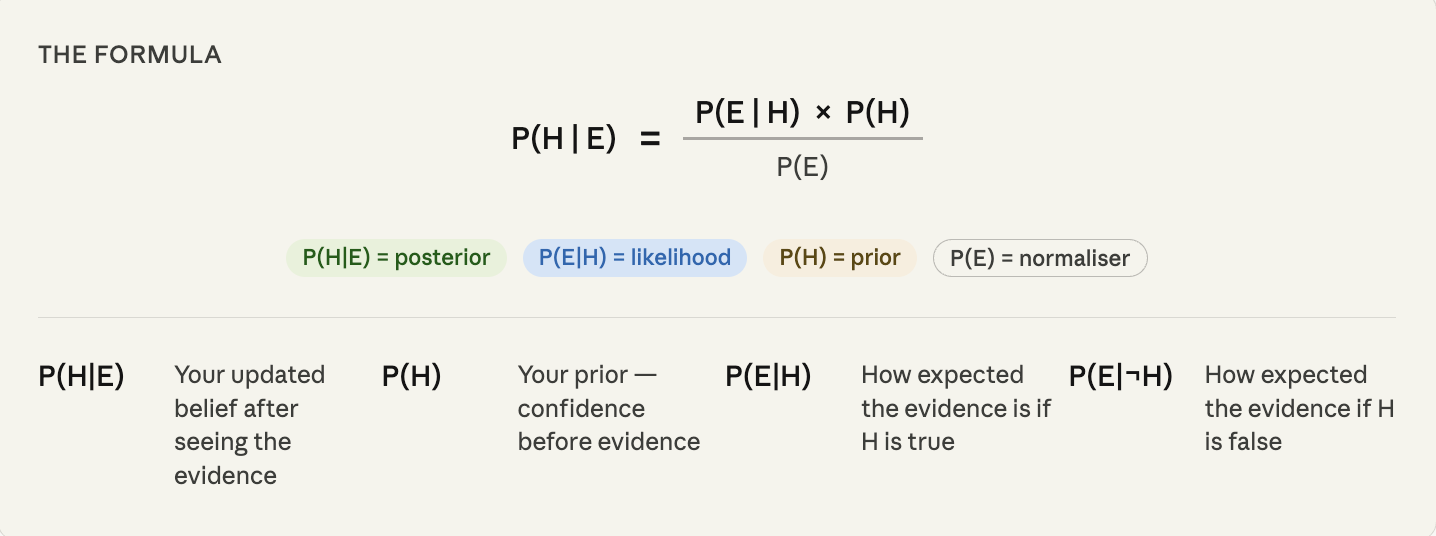
P(H | E) = P(E | H) × P(H) / P(E)
In plain English, piece by piece:
P(H | E) — the posterior — is your updated belief in hypothesis H after seeing evidence E. This is what you’re solving for.
P(H) — the prior — is your starting confidence before the new evidence arrives. In a debate, this is the number you should name at the outset.
P(E | H) — the likelihood — is how expected the evidence would be if your hypothesis is true. If the evidence fits your view perfectly, this is high. If it’s a strange thing to see even if you’re right, it’s low.
P(E) — the normaliser — is how likely the evidence is overall, across all possible explanations. It keeps the math honest.
The key ratio is P(E | H) vs P(E | ¬H): how likely is the evidence if you’re right, versus if you’re wrong? When those two numbers are close, the evidence is weak — it could appear either way. When they diverge sharply, the evidence is strong and your prior should move significantly.
The Problem: We Argue Like Lawyers, Not Scientists
A lawyer’s job is to build the strongest possible case for a predetermined conclusion. Evidence that helps the case gets used; evidence that doesn’t gets minimized or ignored. This is fine in a courtroom. In a conversation between two people who both want to get things right, it’s a slow leak — the reasoning degrades while the positions harden.
Most people argue like lawyers without realizing it. They start with a conclusion — “this policy is wrong,” “my manager made a bad call,” “my read on this situation is correct” — and then selectively gather and present evidence to defend it. When the other person challenges them, they don’t ask “does this challenge move my probability?” They ask “how do I refute this?”
Bayes offers a different frame: what’s your prior, and what would it take to change it?
A prior is just your starting belief before you hear new evidence. If you think there’s a 70% chance your product launch will succeed, that’s your prior. When your co-founder shows you a concerning market survey, Bayes says you should ask: “How likely would I be to see this survey if the launch were going to succeed? How likely if it were going to fail?” The ratio of those two answers tells you how much to revise downward.
You don’t need to run the numbers. But skipping the question entirely — how expected is this evidence if I’m wrong? — is where most reasoning quietly breaks down.
Start every disagreement by naming your prior — how confident are you, and why?
The Skill: Treat Confidence as a Number
When confidence stays vague, it can’t be interrogated — by you or anyone else.
“I think I’m right” is not a useful epistemic state. “I think there’s about a 75% chance I’m right, mostly based on the data from Q3 and what happened at our competitor” is.
This isn’t pedantry. It’s precision. When you put a number on your confidence, three things happen:
First, you’re forced to notice what the number is actually based on. Push on a 90% confidence and you’ll frequently find it resting on two pieces of evidence — one half-remembered, neither recently tested.
Second, it creates a natural opening for the other person. Instead of “I think you’re wrong,” they can say “I’d put that at maybe 50% — here’s what’s pulling me lower.” Now you’re comparing calibrated estimates, not competing certainties.
Third, it makes updating feel natural rather than like surrender. Moving from 75% to 60% isn’t losing the argument. It’s doing the argument correctly.
Researcher Philip Tetlock spent decades studying expert prediction. The people who were most accurate over time — he called them “superforecasters” — shared one trait: they thought in probabilities, updated frequently, and were comfortable saying their confidence had shifted. For them, changing your mind in proportion to evidence wasn’t a concession. It was the mechanism.
Confidence expressed as a number is harder to defend irrationally than confidence expressed as a feeling.
The Practice: Ask What Would Change Your Mind
Here’s the most useful question you can bring into any disagreement: What evidence would change your mind, and by how much?
If someone can’t answer this, the conversation isn’t really a disagreement. It’s a performance. A belief that can’t be updated isn’t a belief held with good reasons — it’s an identity claim dressed as a factual one.
Before your next disagreement, try asking yourself this question privately: if I were wrong about this, what would the world look like? What would I expect to observe that I currently don’t? What would the other person need to show me to shift my probability by 20 points?
Strong priors are legitimate — if you’ve spent ten years in a field, your prior should absorb a blog post lightly. Bayes accounts for this. Strong priors require strong evidence to move — that’s not stubbornness, that’s appropriate calibration.
But if you find that no possible evidence would change your mind, that’s a signal worth sitting with. It means your belief has drifted from reasoning into something else — tribe, identity, ego.
A belief you can’t name the exit conditions for is a belief you don’t really hold — it holds you.
What Good Disagreements Look Like
When two people apply even a loose version of Bayesian reasoning, the conversation changes shape.
Instead of: “You’re wrong about this.” It becomes: “I’m sitting at about 65% on this. Where are you, and what’s driving that?”
Instead of: “That doesn’t prove anything.” It becomes: “That moves me a little, but not far — here’s what I’d need to see to move more.”
Instead of: “I can’t believe you still think that.” It becomes: “We’re reading the same evidence and landing in different places — where’s the actual divergence?”
These aren’t just softer framings. They’re structurally different conversations. Both people leave knowing something they didn’t when they walked in.
The mathematician John Maynard Keynes is often quoted as saying: “When the facts change, I change my mind. What do you do, sir?” Whether he said it exactly that way is disputed. But the sentiment is right. Changing your mind in proportion to evidence isn’t a character flaw. It’s the whole mechanism.
The Takeaway
Before your next real disagreement, do three things:
One. State your confidence as a number, not a feeling. “I’m about 70% sure” beats “I’m pretty sure” every time.
Two. Name what’s actually driving that confidence. Two solid reasons and one half-remembered anecdote is not a 90% prior.
Three. Ask what would move you — and be honest about the answer.
You don’t need to win every argument. You need to be right more often over time. Bayes is the tool for that. It doesn’t require you to be less confident. It requires you to be proportionally confident — which, as it turns out, is much harder and much more useful.